
The $20,000 Commute Mismatch
Every morning, 39,863 Sandoval County residents leave their homes to work in neighboring counties. This daily migration of the Sandoval County labor market represents 60 percent of the entire local working population. The Sandoval County labor market is significantly impacted by this outflow of skilled workers.
At Sandoval Economic Alliance Partner Luncheon on August 13, 2026, Westwood Economics & Planning Associates presented these findings. Co-founders Taner Osman, Ph.D., and Patrick Adler, Ph.D., detailed a significant structural economic imbalance. Sandoval County currently maintains a private-sector job-to-worker ratio of just 0.39. That figure places the county in the 5th percentile among mid-sized counties nationwide. Out of more than 1,600 comparable American counties, 95 percent offer more jobs per resident worker.
This analysis of the Sandoval County labor market highlights a significant structural economic imbalance. This matters because local taxing jurisdictions forfeit substantial commercial tax revenue every day. The Sandoval County labor market is affected as resident talent generates municipal revenue for Albuquerque, Santa Fe, and Los Alamos instead of Sandoval County.
The Data Behind the Regional Brain Drain
The growth in the Sandoval County labor market is noteworthy, with the population increasing rapidly alongside the labor force.
The data suggests that Sandoval County is adding talent faster than almost anywhere in New Mexico. Between 2015 and 2025, the county population grew 14.4 percent to 159,600 residents. During that same ten-year period, the local labor force expanded by 23 percent. That rate exceeded national labor growth by nearly two and a half times. This disparity in qualifications within the Sandoval County labor market highlights the urgent need for local job creation.
The reality on the ground is that local job creation has failed to keep pace with population gains. County resident employment surged 43 percent since 2012. Yet local in-county positions expanded by only 23 percent over that same window. That widening gap pushed 10,000 additional residents onto out-of-county highways each morning.
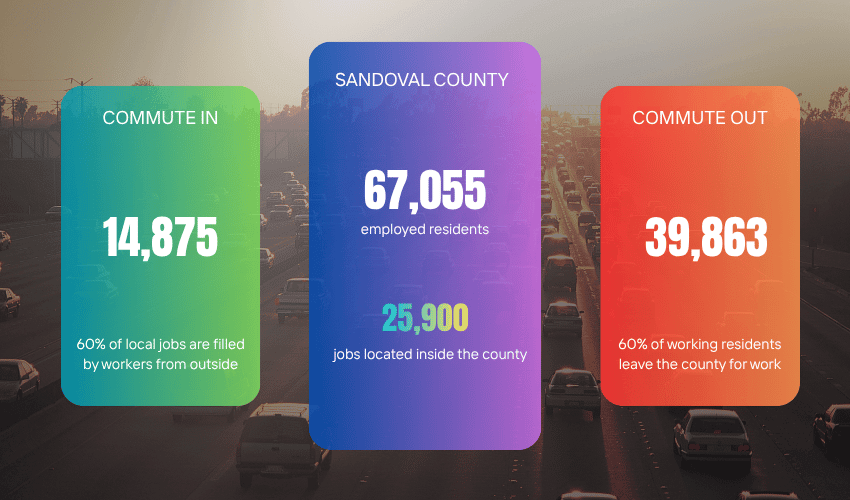
The job deficit in the Sandoval County labor market presents significant opportunities for growth. The asymmetry of regional commuter flows reveals a deep structural imbalance. According to U.S. Census Bureau origin-destination statistics, 39,863 resident workers commute out of Sandoval County each day. Conversely, 14,875 workers commute into Sandoval County from neighboring counties to fill local positions. For every worker entering the county, nearly three workers commute out. Furthermore, out-of-county workers fill 60 percent of all jobs located inside Sandoval County. This cross-commuting pattern demonstrates that local positions fail to match local talent capabilities.
Here is the friction point: out-commuters hold significantly higher qualifications than workers who remain in the county. Forty-seven percent of out-commuters possess an associate degree or higher. By contrast, only 27 percent of in-county workers hold equivalent degrees. Out-commuters earn a mean annual wage of $69,647. Residents working inside Sandoval County earn an average of $49,295. That creates an annual income gap of $20,352 between out-commuters and local workers.
Sector Mismatch: High-Tech Talent vs. Local Employment Base
There is a catch, though: local businesses are not hiring for the high-tech skills that resident workers possess. More than 26.9 percent of out-commuters work in professional, technical, and business services. Yet that high-paying sector accounts for only 4.8 percent of all jobs located inside Sandoval County.
Instead, internal county employment remains concentrated in lower-wage and service sectors. Retail trade accounts for 15.8 percent of local jobs. Leisure and hospitality represents another 15.5 percent of local positions. Healthcare accounts for 15.4 percent of internal jobs, despite a resident workforce surplus of 10,805 healthcare workers.
Manufacturing stands out as a notable exception to this rule. Sandoval County holds 4,106 manufacturing jobs, representing 15.9 percent of local employment. Intel’s semiconductor fabrication facility in Rio Rancho drives this industrial concentration. Capital announcements like Project Ranger, a $220M commercial development, demonstrate the impact of high-value industrial expansion. However, commercial real estate development and site selection must expand beyond single manufacturing anchors.
The 23,000 Job Deficit and the Site Selection Opportunity
Strategies must be implemented to bolster the Sandoval County labor market effectively. Addressing this job deficit can enhance the Sandoval County labor market’s viability.
If Sandoval County matched the national median job-to-worker ratio of 0.71 for mid-sized counties, it would support 48,670 local jobs. Sandoval County currently contains only 25,527 local private-sector jobs. That calculation reveals an untapped capacity of 23,143 positions.
Site selection executives and corporate leadership spend millions recruiting technical talent in competitive markets. Sandoval County already houses this talent pool. Seventy-nine percent of out-commuters head directly into Bernalillo County each day. They work at Sandia National Laboratories, Kirtland Air Force Base, and regional health systems. Sixty-five percent of out-commuters work in Albuquerque. Seventy-two percent of all out-commuters originate from Rio Rancho.
Corporate site selection teams do not need to import talent to Sandoval County. The engineers, computer scientists, and healthcare specialists already live here. Regional math and computer occupations are growing at a 10.1 percent rate. These professionals simply commute south every morning because local commercial office space and corporate positions do not yet exist.
The Property Tax Asymmetry: Residential Caps vs. Commercial Growth
Local governments must collaborate to enhance the Sandoval County labor market. The fiscal math reveals a severe structural limitation for municipal balance sheets. New Mexico state law caps annual residential property valuation increases at three percent for tax assessment purposes. Sandoval County and municipal budgets rely overwhelmingly on residential real estate. Consequently, residential property tax collections cannot keep pace with municipal inflation, public safety costs, or infrastructure maintenance.
Commercial real estate faces no such statutory assessment cap. Expanding the commercial tax base allows local governments to capture full market-value assessments as assets appreciate. Commercial real estate expansion also generates sustained gross receipts tax revenues without placing additional burden on residential homeowners. Municipal leaders in Rio Rancho and Sandoval County achieve long-term fiscal stability when local land use shifts toward high-value commercial development and employer headquarters.
Strategic Collaboration: Bridging City, County, and State Priorities
Ultimately, strengthening the Sandoval County labor market will benefit the entire region. Closing this 23,000-job deficit requires structured, multi-jurisdictional alignment. No single entity can resolve a structural mismatch of this scale in isolation. The city, the county, and the state must engage in deliberate strategic dialogues to align public policy with market opportunities.
The bottom line is this: municipal, county, and state leaders must collaborate to create an environment where commercial employers can thrive locally. Rio Rancho, Sandoval County, and New Mexico state agencies share a common economic interest in capturing resident talent.
City leaders in Rio Rancho control critical land-use planning, municipal zoning, and local commercial infrastructure. County officials oversee broader regional services and tax structures. State leaders direct major economic development incentives and workforce development resources. When these three tiers of government align their priorities, corporate site selection decisions become seamless.
Public sector collaboration must focus on removing structural barriers to commercial growth. Strategic dialogues between city, county, and state leadership should focus on three operational priorities.
First, public leaders must align municipal zoning and infrastructure investments with high-value commercial development. Corporate office parks, research facilities, and medical campuses require flexible zoning and ready utility capacity.
Second, state and local officials must coordinate economic development incentive packages. Aligning state incentives with city and county tax structures will make Sandoval County competitive for corporate relocations.
Third, state educational institutions and local governments must partner with site selection advisors. Demonstrating a ready talent pool of 40,000 skilled out-commuters will convince corporate leadership to establish local operations.
A Unified Framework for Regional Growth
Sandoval Economic Alliance serves as the convener for these vital conversations. By bringing together city officials, county commissioners, state policymakers, and corporate executives, regional alignment becomes achievable.
Municipalities in Sandoval County gain substantial fiscal resilience when residents work locally. Local employment keeps gross receipts tax revenues within city and county borders. Uncapped commercial property growth delivers predictable funding for roads, public safety, parks, and community infrastructure.
Commercial real estate developers gain immediate access to a highly educated talent pool. Corporate executives gain a competitive recruiting advantage by reducing employee commute times and offering a higher quality of life.
The labor force is the hardest part of economic development to build. Sandoval County already possesses New Mexico’s most qualified labor pool. City, county, and state leaders now have a clear empirical foundation to guide joint action. Through sustained strategic dialogue and coordinated planning, regional partners can transform daily out-commuters into local commercial assets.