
Primary sector employers in Sandoval County & Rio Rancho businesses entered the survey period on a foundation of steady operational stability, with 85.7% of surveyed enterprises in 2025 predicting positive annual sales revenue. As macro economic headwinds mounted, including a federal 50% tariff on imported structural steel, multi-state sales tax compliance hurdles, and escalating health insurance overhead, local leadership faced a potential margin squeeze. Rather than retrenching or cutting operations, businesses in Sandoval County / Rio Rancho launched a proactive efficiency drive, prioritizing high-density technical hiring and internal productivity over expansive real estate additions.
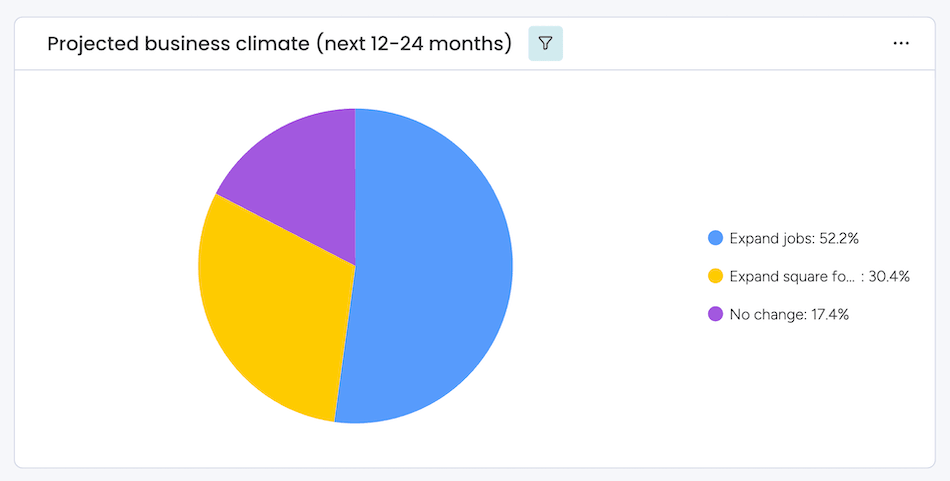
This operational turn led to a notable shift in workforce momentum. Planned job reductions fell from 10.8 positions per firm in 2025 down to zero in 2026, driving average net planned job growth per reporting company up from 8.7 positions in 2025 to 21.2 positions in 2026. Furthermore, 94.1% of participating firms in 2026 expect revenue growth over the next 12 months, reflecting high underlying enterprise confidence.
Sandoval County now stands as a high-density, highly resilient industrial hub within New Mexico. To capture this momentum, Sandoval Economic Alliance (SEA) is positioned to lead targeted workforce development initiatives, and help expansion-minded partners secure viable local opportunities in the Sandoval County & Rio Rancho Business landscape.
Key Metrics & Sentiment Comparison Table
Note: Because total survey participation varied between sample years, figures are presented as normalized per-firm averages, proportions, or percentage distributions to ensure accurate year-over-year evaluation.
| Indicator / Metric | 2025 BR&E Survey (n=21) | 2026 BR&E Survey (n=17) | Normalized Year-over-Year Shift |
|---|---|---|---|
| Gross Jobs Added per Reporting Firm | 19.5 new jobs / firm | 21.2 new jobs / firm | +1.7 jobs / firm (+8.7%) |
| Gross Jobs Reduced per Reporting Firm | 10.8 cut jobs / firm | 0.0 cut jobs / firm | -10.8 cut jobs / firm (-100.0%) |
| Net Jobs Created per Reporting Firm | +8.7 net jobs / firm | +21.2 net jobs / firm | +12.5 net jobs / firm (+143.7%) |
| Firms Planning Headcount Expansion | 57.1% of companies | 70.6% of companies | +13.5 percentage points |
| Firms Planning Headcount Reduction | 4.8% of companies | 0.0% of companies | -4.8 percentage points |
| Floor Space Added per Reporting Firm | 6,377 sq. ft. / firm | 1,839 sq. ft. / firm | -4,538 sq. ft. / firm (-71.2%) |
| Firms Planning Physical Expansion | 28.6% of companies | 35.3% of companies | +6.7 percentage points |
| Anticipating Positive Sales Growth | 85.7% of companies | 94.1% of companies | +8.4 percentage points |
| Local Climate (Good / Very Good) | 52.4% of companies | 41.2% of companies | -11.2 percentage points |
| State Climate (Good / Very Good) | 38.1% of companies | 23.5% of companies | -14.6 percentage points |
| National Climate (Good / Very Good) | 52.4% of companies | 41.2% of companies | -11.2 percentage points |
| In-State NM Sourcing Share | 22.2% average share | 22.2% average share | 0.0 percentage points |
| Domestic US Sourcing Share | 60.7% average share | 51.2% average share | -9.5 percentage points |
| International Sourcing Share | 19.1% average share | 26.6% average share | +7.5 percentage points |
| Top Recruitment Barrier: Skills Gap | 19.0% of companies | 52.9% of companies | +33.9 percentage points |
Opportunities in Sandoval County & Rio Rancho Business Landscape: Strategic Insights & Hidden Market Signals
High-Density Talent Scaling Replaces Real Estate Expansion
Evaluating metrics on a per-firm basis reveals a clear operational pivot across local technology, aerospace, and advanced manufacturing sectors. While floor space additions moderated from 6,377 square feet per firm in 2025 down to 1,839 square feet per firm in 2026, the percentage of companies actively hiring grew from 57.1% to 70.6%. Employers are maximizing production output within their existing footprints by deploying capital into advanced technology and high-yield positions rather than speculative real estate. This efficiency strategy demonstrates strong economic maturity and offers prospective investors a highly concentrated industrial baseline in Rio Rancho.
The Recruitment Challenge: From Candidate Quantity to Specialized Technical Skills
A major shift occurred in workforce dynamics. In 2025, 28.6% of companies identified a general lack of local applicants as their primary hiring friction. By 2026, concern over candidate volume dropped to 5.9%, while 52.9% of firms cited difficulty finding applicants with specific technical skills or specialized industry experience. Industry demands have outpaced the speed of specialized vocational pipelines in machining, electronics, HVAC, drafting, and healthcare. Bridging this technical gap through targeted apprenticeships and regional training initiatives represents SEA’s highest-leverage workforce priority.
Sourcing Adaptation Amid Supply Chain Regulations
Despite growing concern over federal tariffs, such as the 50% tariff on steel cited by local fabricators, international supply sourcing increased by 7.5 percentage points to reach 26.6% of total inputs. Meanwhile, domestic U.S. sourcing fell from 60.7% to 51.2%. This movement indicates that specialized components and raw material dependencies remain difficult to substitute domestically. Small businesses reported significant resource drains trying to navigate tariff compliance and multi-state tax rules. SEA can deliver immediate client value by organizing supply-chain match programs and providing guidance on navigating international trade policies.
Policy Friction and Incentive Modernization
Favorable sentiment regarding the State business climate declined from 38.1% in 2025 to 23.5% in 2026. Qualitative comments emphasize that while manufacturing incentives remain helpful, established service providers, medical practices, and commercial contractors feel excluded from state growth programs despite employing sizable local workforces. Employers called for Gross Receipts Tax (GRT) reform, streamlined local permitting, and broader economic incentive criteria. SEA is well-positioned to serve as an active policy advocate, ensuring local business conditions support long-term regional expansion.