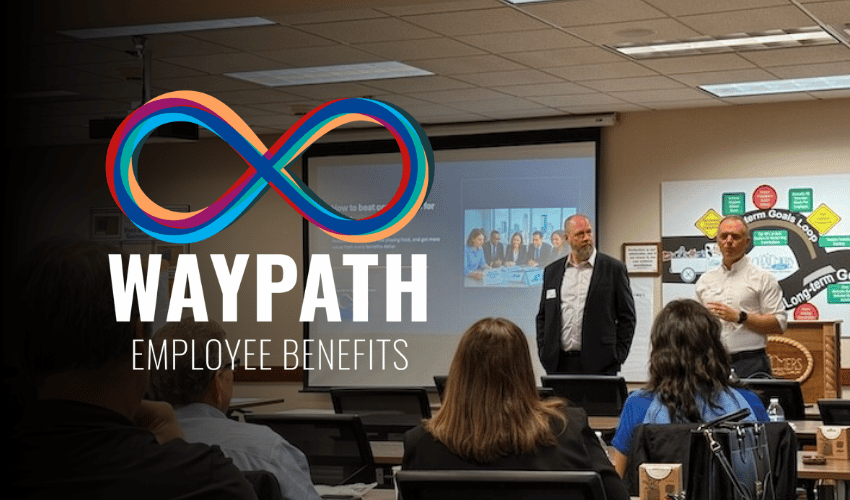
At this morning’s SEA Partner Breakfast (September 17, 2026), Dave Tvedt and Adam Frost of Waypath Employee Benefits laid out a hard truth for Sandoval County employers: the math behind employee benefits strategy has changed, and the businesses that treat renewal season like a shopping trip instead of a financial strategy are going to lose good people over it.
The pressure is real, and it’s not just one bad year
The numbers Waypath presented are blunt. The average annual family premium in employer-sponsored coverage now sits near $27,000. Commercial medical cost trend is projected at 9 percent for 2027. New Mexico’s ACA Marketplace premiums are approved to rise a median of 24.4 percent next year. None of this comes from a single cause. Hospital and outpatient prices keep climbing as more care shifts to costlier settings. Specialty drugs and GLP-1 demand are reshaping pharmacy budgets. Patients who delayed care during leaner years are returning with more complex, more expensive needs. Insurers are correcting margins after several years of underpricing. And policy shifts around ACA subsidies are rippling into what employers pay too.
Implementing an effective employee benefits strategy is crucial for small businesses aiming to reduce turnover and retain top talent.
Put together, a renewal that used to feel like “last year plus a little inflation” now feels unpredictable, because it is not a repeat of last year. It is a forecast of next year’s risk, built on your workforce’s age and family mix, your claims history, and the assumptions carriers bake into their contracts.
Turnover is the cost most businesses underprice
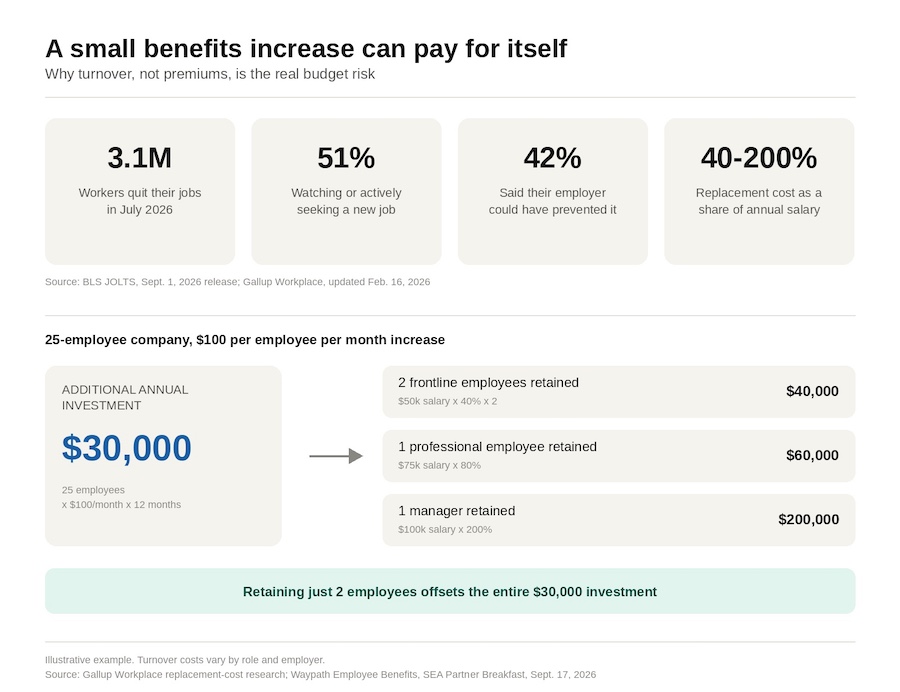
Here is where the presentation got interesting for a Sandoval County audience specifically focused on workforce retention. According to the Bureau of Labor Statistics, 3.1 million U.S. workers quit their jobs in July 2026 alone. Gallup data shows 51 percent of employees are watching or actively looking elsewhere, and 42 percent of people who left a job voluntarily say their employer could have done something to prevent it. Replacement cost runs 40 to 200 percent of a role’s annual salary once you count lost productivity, training time, and manager disruption.
Waypath ran the numbers on a hypothetical 25-employee company that adds $100 per employee per month in benefits, a $30,000 annual investment. Retaining just one manager who would have otherwise cost 200 percent of a $100,000 salary to replace covers the entire investment twice over. Retaining two frontline workers at 40 percent of a $50,000 salary covers it too. The presentation’s point was simple: the cheapest health plan on paper is not always the cheapest plan for the business once turnover is factored in.
Why perception beats the paycheck
One of the sharper insights from the session involved how employees actually experience a raise versus a benefit. A $1,000 annual raise costs an employer roughly $25,000 a year for 25 employees, once payroll taxes are included, but after federal, FICA, and New Mexico state withholding, the employee only sees about $29 more per paycheck. Compare that to $50 a month in fully paid dental and vision, which costs the employer $15,000 a year and shows up to the employee as a zero-dollar deduction and a benefit they can see and use immediately. The same logic applies to a modest HSA contribution or basic life and disability coverage. A smaller, more visible investment can outperform a bigger number buried in a paycheck.
A plan for local businesses, not just large employers
For a business community built mostly on small and mid-sized firms, the toolbox Waypath outlined matters. Traditional group plans still make sense when simplicity and network stability come first. Level-funded plans can reward healthier claims history. Self-funded or captive arrangements give larger employers more control but require real appetite for risk. And ICHRA, or individual coverage health reimbursement arrangements, let an employer set a fixed, predictable contribution while employees choose their own individual coverage, shifting the annual renewal shock away from the business without cutting employees loose.
The presentation closed with a timeline worth repeating: start the process 90 days before renewal by collecting census data, claims history, and employee feedback, not 30 days out when the only choice left is to accept or reject a number a carrier already decided for you.
For Sandoval County, this connects directly to a labor market where employers are already competing against Albuquerque wages and a wider region for technical and skilled talent. A benefits strategy built with intention, rather than renewed on autopilot, is one more tool that keeps good people from walking down the road for a marginally bigger paycheck. SEA thanks Dave Tvedt and Adam Frost of Waypath Employee Benefits for sharing this data with our partner network.
Data Sources
- KFF Employer Health Benefits Survey 2025
- PwC Medical Cost Trend 2027
- Health System Tracker / KFF 2027 ACA rate filing analysis
- EBRI 2025 employer survey on voluntary benefits and retention/recruiting impact
- BLS JOLTS release, September 1, 2026
- Gallup Workplace, updated February 16, 2026
- IRS Publication 15-B and IRS 2026 tax brackets
- IRS Publication 969
- HealthCare.gov ICHRA and individual coverage HRA guidance
- Waypath Employee Benefits, SEA Partner Breakfast presentation, September 17, 2026