
For any company weighing a move into the Southwest, Intel’s Rio Rancho campus is not just a neighbor. It is a 45-year proof point that this region can support high-value, capital-intensive manufacturing at scale, and the newest numbers back that up.
According to Intel’s own economic impact briefing, the company has put $17.68 billion into New Mexico since 1980, with an annual economic impact of $1.2 billion. The Rio Rancho site alone employs 2,770 full-time workers, and 74 percent of the people Intel hired in 2025 were New Mexicans. Add in the ripple effects, roughly 7,000 New Mexico jobs supported directly and indirectly, $300 million spent with in-state businesses in 2023, and 4,000 to 5,000 employees, tradespeople, and vendors passing through the gates every single day, and you get a picture of a facility that behaves less like a single tenant and more like a small local economy.
That is the number a growing business should sit with for a moment. A facility generating that much daily foot traffic and vendor spend has already built the supply chain, logistics network, and skilled labor bench that a new manufacturer would otherwise have to create from nothing. Think of it the way a farmer thinks about topsoil. Intel did not just plant one large crop in Rio Rancho. It spent four decades enriching the ground underneath it, and everything planted nearby benefits from that same soil.
The workforce math changes the risk calculation
Every expansion decision treats recruitment as a risk line item. How long will it take to staff the plant? Will the technical skills exist locally, or will the company need to import talent at a premium? Rio Rancho answers that question differently than most competing markets.
Intel’s presence has spent four decades training semiconductor technicians, process engineers, and equipment specialists in this exact labor market. That is a location quotient advantage that cannot be built overnight. A supplier, a packaging partner, or an adjacent tech manufacturer moving into Sandoval County does not need to seed a workforce pipeline from zero. It can draw from a labor pool that already understands cleanroom protocols, statistical process control, and the operational discipline a fab demands. Local partners matter here too. CNM’s technical training programs and RioTECH’s workforce initiatives were built specifically to keep that pipeline full, so the advantage does not fade as older technicians retire.
This matters even more given where Intel’s Rio Rancho operations are headed next. Reporting earlier this year found the site is expanding its equipment, floor space, and workforce to serve a growing list of outside customers, driven by demand for AI chips, high bandwidth memory, and co-packaged optics, with glass substrates emerging as a new area of focus. Federal documentation from NIST separately confirms the Rio Rancho site’s role as a modernization hub for advanced packaging, one intended to become the largest advanced packaging facility in the United States once fully online.
In plain terms, Intel is not winding down in Rio Rancho. It is retooling for the next decade of chip demand. That is a signal worth paying attention to for any company that supplies materials, logistics, specialty gases, or components into a semiconductor packaging supply chain.
Capital efficiency and operational endurance
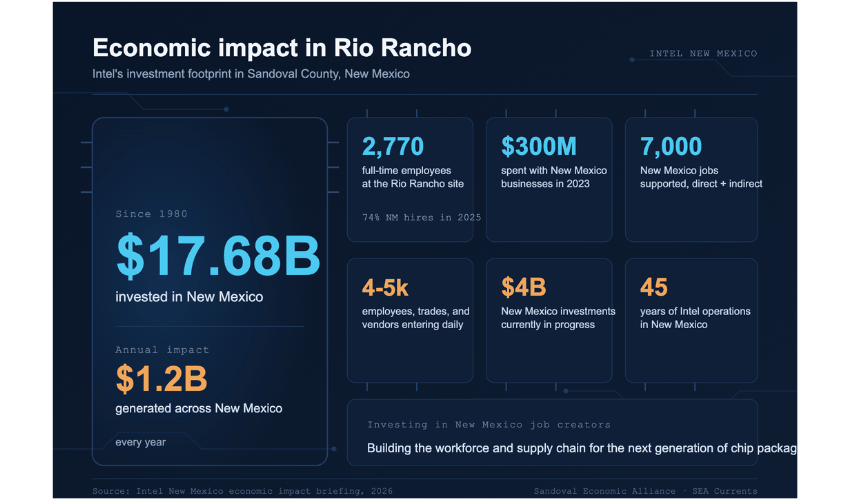
Companies evaluating a new location often ask a simple question: has this place proven it can absorb billions of dollars in capital investment without the surrounding infrastructure, permitting process, or utility grid buckling under the weight? Rio Rancho has answered that question multiple times, through Intel’s Fab 9 buildout, the $500 million CHIPS Act supported modernization, and now this packaging-focused expansion. With $4 billion in New Mexico investments currently in progress, that pattern shows no sign of slowing down.
That track record reduces a specific kind of risk that rarely gets modeled explicitly: the chance that a region’s physical infrastructure cannot keep pace with a company’s growth curve. A site that has already absorbed four decades of expansion cycles has, by definition, demonstrated operational endurance. Roads, water, power, and permitting processes have all been stress tested by a tenant far larger than most companies considering the move today.
For a company evaluating capital efficiency, that history also lowers the due diligence burden. Instead of estimating how a market might respond to a large capital project, a business can point to Intel’s own investment curve as a real world case study of what this county can support. It is one thing to promise a company that the grid can handle new load. It is another to show forty years of receipts proving it already has.
What this means for Sandoval County
The story here is not just “Intel is big.” It is that a technically skilled, semiconductor-tested workforce already exists in Rio Rancho, that the physical and utility infrastructure has already absorbed billions in capital spending without failure, and that the site’s next chapter, AI-driven packaging demand, is pulling more investment in, not less. For any manufacturer in the semiconductor supply chain, or any company that simply wants proof a region can handle serious capital projects, that combination is hard to find anywhere else in the Southwest. Intel built the foundation. The opportunity now is for the next wave of companies to build on top of it.