
New Mexico developers can now combine Industrial Revenue Bonds with private clean energy financing to fund 100 percent of commercial building upgrades. This legislative shift, enacted under House Bill 165, eliminates the legal friction that previously blocked dual-incentive projects.
The data suggests that capital stacks for large-scale industrial projects are becoming increasingly complex. Previously, developers using Industrial Revenue Bonds (IRBs) could not access Commercial Property Assessed Clean Energy (C-PACE) funding. This matters because IRBs are the primary tool for driving multi-million dollar business expansion projects in New Mexico. C-PACE offers up to 100 percent financing for energy and water efficiency upgrades.
The data suggests that capital stacks for large-scale industrial projects are becoming increasingly complex. Previously, developers using Industrial Revenue Bonds (IRBs) could not access Commercial Property Assessed Clean Energy (C-PACE) funding. This matters because IRBs are the primary tool for driving multi-million dollar business expansion projects in New Mexico. C-PACE offers up to 100 percent financing for energy and water efficiency upgrades.
Here is the friction point: municipal bond ownership previously clouded property titles for private lenders. Because local governments technically hold nominal title to real estate in an IRB transaction, private C-PACE lenders lacked legal clarity regarding foreclosure and repayment.
House Bill 165 solved this structural problem. The law clarifies that lessees and owners, rather than local governments, are solely responsible for C-PACE repayment. This statutory change gives private capital providers the security they need. The program requires no public funds. Repayment occurs over a period of up to 30 years through a voluntary property assessment.
Resolving the Underwriting Friction Point
Private C-PACE financing acts as a long-term, non-recourse senior debt alternative. Lenders fund up to 100 percent of the energy-related construction costs. The security for this capital is a voluntary assessment lien placed on the property. This lien has equal priority to a municipal tax assessment.
Under previous statutes, this municipal priority created immediate structural conflicts with Industrial Revenue Bonds. This matters because it forced developers to choose between property tax abatements and low-cost utility financing.
House Bill 165 directly resolves this structural conflict. The new law confirms that the private lessee holds the payment obligation. The municipal bond issuer bears zero financial liability. Consequently, commercial mortgage lenders can now grant consent for C-PACE assessments on IRB-financed properties.
This statutory resolution alters the underwriting for industrial triple-net leases. In a standard industrial lease, the tenant pays all utility expenses and property taxes. If a developer installs premium HVAC systems, the developer incurs the heavy upfront capital cost. The tenant receives the direct benefit of lower utility bills.
This split incentive frequently stalls energy efficiency upgrades in commercial developments.
The bottom line is this: C-PACE eliminates this structural barrier entirely. Because C-PACE is repaid via a property tax assessment, the payment naturally passes through to the tenant. The tenant pays the assessment but experiences an immediate, offsetting reduction in utility expenses. In highly efficient buildings, the utility savings often exceed the C-PACE payment. This results in a net-positive cash flow for the tenant from day one.
Aligning Industrial Upgrades with Labor Projections
This financing model will drive significant changes in regional labor demands. Building highly efficient industrial facilities requires specialized, high-skill labor. The construction sector must shift toward advanced systems installation. This includes smart grid integration, automated building controls, and commercial solar arrays.
The reality on the ground is that New Mexico is preparing for this technological transition.
State projections indicate a strong growth trend in technical roles. For instance, math and computer occupations are projected to grow by +10.1 percent. These high-wage roles are critical for managing the automated software and energy management platforms in modern industrial facilities.
There is a catch, though: the local workforce must scale to meet these technical requirements. Sandoval Economic Alliance is actively coordinating with regional educational institutions to align training programs with these emerging industrial requirements. Ensuring a steady pipeline of systems engineers and technical project managers is a priority.
The Cost Competitive Advantage in Sandoval County
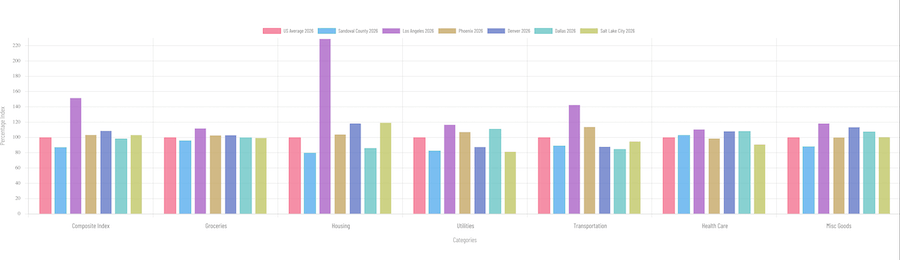
For global companies analyzing site selection, these financing mechanics are crucial. Rio Rancho is rapidly becoming a premier hub for high-tech manufacturing. The area attracts companies due to its infrastructure, competitive cost structure, and technical labor pool.
The data suggests that the Sandoval-Rio Rancho metro area maintains an exceptional cost advantage. According to 2026 Council for Community and Economic Research data, the Sandoval-Rio Rancho metro area has a composite index of 87.2. This is significantly lower than the national average of 100. It makes the region highly attractive for manufacturing companies seeking to manage operational overhead.
This matters because lower overhead, combined with cheap capital, increases the feasibility of major industrial developments.
Sandoval Economic Alliance is already utilizing this new capital structure to attract large-scale projects. The largest example of industrial growth in the region is Project Ranger. This massive $220 million manufacturing facility highlights the scale of modern industrial development in Rio Rancho.
Under the old regulatory framework, a project of this magnitude would have to choose between IRB tax benefits and C-PACE utility savings. Now, developers can combine both.
By utilizing C-PACE alongside IRBs, developers of future large-scale projects can install commercial-grade solar arrays. They can also deploy low-flow industrial water recycling systems and smart HVAC infrastructure. This reduces the long-term utility burden on the tenant. It also secures the asset value for the lender.
Municipal Utility Deflection and Community Benefits
Beyond individual building balance sheets, the broader community experiences a compounding benefit. When private capital funds 100 percent of these upgrades, it reduces the strain on public municipal utilities. Lower water consumption and reduced peak-load electricity demand defer the need for expensive public infrastructure expansions.
This matters because local governments can redirect public capital toward roads, public safety, and schooling.
The environmental impact is equally concrete. The statewide C-PACE program has already supported nearly $146 million in projects. These transactions have directly lowered carbon emissions and reduced water waste.
By expanding this program to IRB properties, the state opens a vast inventory of commercial and industrial acreage to modernization. Older industrial parks can now undergo deep energy retrofits without requiring public taxpayer subsidies.
For site selectors and industrial developers, the updated New Mexico capital stack is highly competitive. The combination of a 93.1 cost of living index in Sandoval County and flexible, dual-incentive financing creates a compelling business expansion case.
Sandoval Economic Alliance is prepared to assist your company on how to structure these transactions. By combining private capital, local tax incentives, and a skilled technical workforce, the region is setting a new standard for industrial growth.