This blog is available in SEA Podcast: Listen to our analysis of the Speed to Power Paradox.

For decades, the “Big Three” of site selection were Location, Labor, and Logistics. But as we cross into 2026, a new titan has toppled the hierarchy.
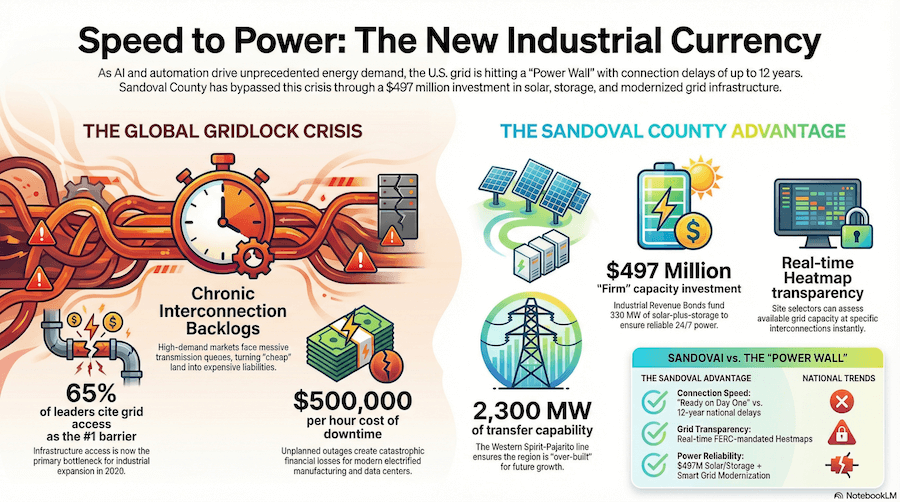
In a world of electrified manufacturing and AI-driven data centers, power is no longer just a utility; it is the ultimate industrial currency. Recent analysis from the Energy Outlook 2026 confirms this shift: infrastructure, specifically power grid access, is now cited by 65% of senior energy and industrial leaders as the single greatest barrier to expansion.
This isn’t just about the cost of a kilowatt-hour; it’s about the Speed to power—how fast a company can plug into a reliable grid and start producing. Understanding the Speed to power is critical for manufacturers aiming to thrive in this new landscape.
The National Gridlock: A 2026 Reality Check
The United States is currently facing what experts call the “Interconnection Queue Crisis.” According to the U.S. Energy Information Administration (EIA), electricity demand is projected to hit record highs in 2026, reaching over 4,200 billion kWh.
The driver? A massive surge in “compute” power for AI and the rapid electrification of the industrial base.
In high-demand markets like Northern Virginia (PJM) and Texas (ERCOT), the surge has pushed grids to their breaking point. In early 2026, reports emerged of data center developers facing transmission connection delays of up to 12 years.
In this “Speed to Power” paradox, a “cheap” site in a congested market becomes an expensive liability if a company has to wait a decade to turn the lights on.
The Sandoval Advantage: Reliability by Design
While other regions scramble to retrofit aging infrastructure, Sandoval County and New Mexico are moving in the opposite direction: proactive modernization.
PNM, the state’s largest utility provider, is currently executing a massive grid modernization rollout. On November 10, 2025, PNM officially launched phase one of this plan, installing advanced network devices that form the backbone of a “smarter, stronger” grid.
By the end of 2026, the deployment of Advanced Metering Infrastructure (AMI) will be fully underway, providing businesses with real-time energy monitoring and faster outage restoration.
Key Data Points for Sandoval County:
- The $497 Million IRB: In July 2025, Sandoval County authorized nearly half a billion dollars in Industrial Revenue Bonds for the Diamond Tail Solar and Storage Project. This 330 MW facility, which includes a massive Battery Electric Storage System (BESS), is designed to provide “firm” capacity—reliable power that keeps flowing even when the sun goes down. Source: Sandoval County
- Interconnection Transparency: Unlike states that operate in a “black box,” New Mexico utilizes a FERC-mandated Heatmap. This tool allows site selectors to assess available grid capacity at specific points of interconnection in real-time. Source: PNM
- System Capacity: The Western Spirit-Pajarito line provides over 2,300 MW of transfer capability into the Albuquerque-Sandoval corridor, ensuring the region isn’t just keeping pace with demand but is actually “over-built” for future industrial growth.
The Hidden Cost of Downtime
For a business owner, the ROI of a location is now mathematically tied to grid resilience. According to 2026 industrial research from ABB, unplanned downtime now costs manufacturers between $260,000 and $500,000 per hour.
For 7% of large-scale enterprises, that figure exceeds $1 million per hour.
In Sandoval County, the grid is transitioning from a traditional one-way power source to a dynamic, multi-functioning system. Through PNM’s modernization (Case No. 25-00049-UT), the integration of smart sensors allows for predictive maintenance, identifying potential failures before they lead to a $500k-per-hour catastrophe.
This technological layer acts as a risk-mitigation tool for partners, ensuring that “Speed to Power” isn’t just about the initial connection, but long-term operational uptime.
Scaling for the “Electric Economy”
As we look toward the remainder of 2026 and beyond, the competitive landscape for Sandoval County has shifted. We are no longer just competing on real estate; we are competing on the ability to provide an uninterrupted flow of electrons to the industries of tomorrow.
Whether it is a semiconductor facility requiring massive voltage stability or a regional logistics hub moving toward an all-electric fleet, the infrastructure in Sandoval County is being built to handle the load.
The state’s One Big Beautiful Bill energy legislation has provided the regulatory framework to ensure that renewable integration—like the solar-plus-storage projects in Bernalillo—enhances rather than complicates grid reliability.
Positioning for the Future
The era of taking power for granted is over. As site selectors and business owners look toward the next decade, the primary question has shifted from “where is the labor?” to “where is the power?”
Sandoval County has positioned itself at the intersection of reliability and readiness. With a modernized grid, aggressive battery storage integration, and a transparent interconnection process, we aren’t just providing a place to build—we are providing the energy to scale on Day One.
For site selectors, the “Speed to Power” in Sandoval County isn’t just a metric; it’s a competitive advantage that directly impacts the bottom line.