From “Why” to “How” – Making AI Work for Your Business
Part 1 of this series established the undeniable imperative for small and medium-sized enterprises (SMEs) to adopt technology, highlighting the significant economic shifts and competitive pressures at play. This second installment transitions from the “why” to the practical “how.” Here, the focus shifts to exploring key emerging trends and showcasing concrete, actionable applications across vital SME functions, including marketing, sales, web development, graphic design, and data management. The aim is to inspire SMEs with accessible examples and demonstrate how modern tools can be integrated to foster efficiency, innovation, and growth.
The Democratization of Technology: Accessible Power for Every SME
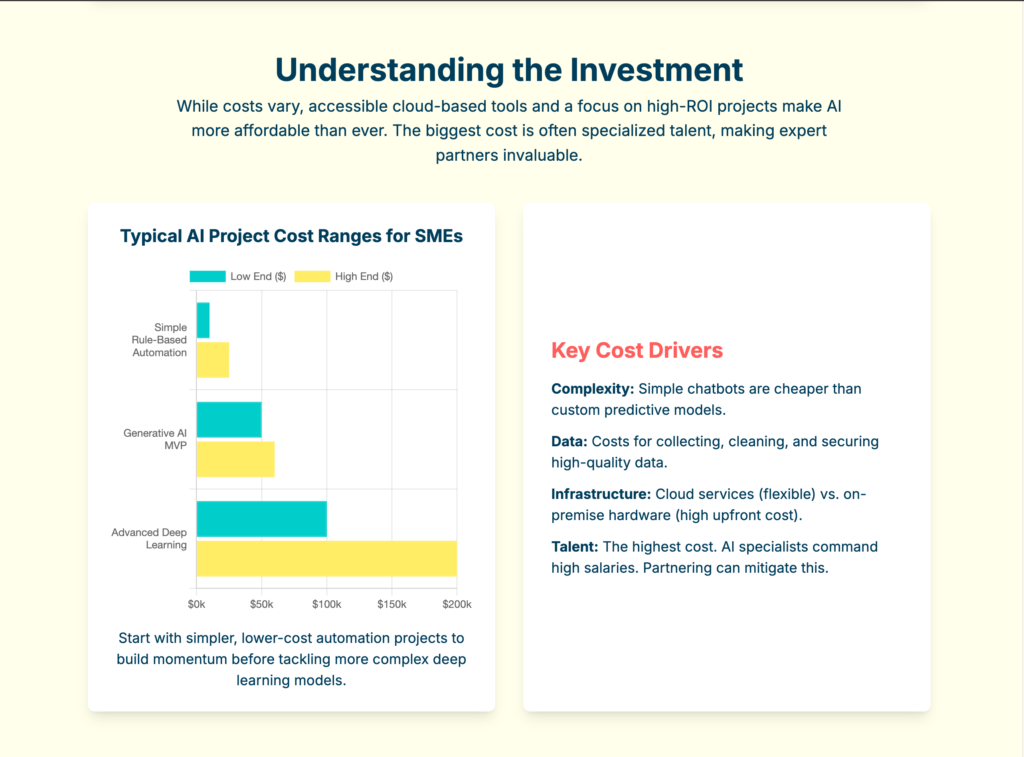
A significant trend making adoption more feasible for SMEs is the democratization of technology. Driven tools are no longer exclusively for large corporations with massive budgets; they are becoming increasingly accessible to small and midsize businesses. This transition from a mere buzzword to an integral business tool, with a survey by The SMB Group revealing that two-thirds of small business owners already report a “very big or modest impact” from technology on their operations. A key enabler of this accessibility is the proliferation of cloud-based tools, which allow small businesses to adopt capabilities without requiring huge upfront investments in infrastructure or specialized personnel.
The democratization of technology is not merely about making it available, but about leveling the playing field. Cloud-based tools significantly lower the barrier to entry, enabling SMEs to access sophisticated capabilities that were once exclusive to large enterprises. This means that SMEs can now compete more effectively on innovation and efficiency, rather than solely on scale. Therefore, SMEs should prioritize exploring cloud-based, off-the-shelf solutions or platforms with integrated features to minimize initial investment and technical overhead, making adoption a more manageable and cost-effective endeavor.
AI Across Your Core Business Functions
The versatility of modern technology allows it to be integrated across nearly every facet of an SME’s operations, delivering tangible improvements.
A. Marketing & Sales: Supercharging Your Growth Engine
Tools are revolutionizing marketing and sales by assisting with everything from generating personalized email campaigns to optimizing ad spending and analyzing customer behavior.
- Personalized Recommendations & Hyper-Personalization: AI can predict customer behavior, tailor content and deals, and fine-tune campaigns on the fly, leading to more relevant and effective outreach. Platforms like Salesforce Einstein analyze customer data to deliver highly personalized marketing content, which significantly boosts engagement and conversion rates. A notable example is Nutella’s “Unica” campaign, which used an AI algorithm to generate 7 million unique packaging designs, transforming supermarket shelves into mini art galleries and making jars collectible. Similarly, Volkswagen leveraged AI to analyze browsing patterns, search intent, and past interactions, resulting in optimized media budgets, lower costs per lead, and increased showroom visits. The increasing integration of AI in customer interactions is evident, with predictions that over 95% of customer support interactions will involve AI by 2026.
- Content Generation & Optimization: AI writing tools such as ChatGPT, Jasper, and Copy.ai support the creation of first drafts for copy, product descriptions, blog ideas, and headlines. One e-commerce business reported reducing content production time by half using AI tools for drafts, with human input for refinement. AI can also generate and schedule social media posts across multiple platforms and develop engaging content based on trending hashtags and topics.
- Lead Generation & Management: AI can group audiences into micro-segments based on behavior, preferences, and purchase intent, enabling highly targeted messaging. Furthermore, AI can route and enrich incoming leads, and prioritize them with intelligent scoring, ensuring that sales teams focus on the most promising prospects.
The combination of technology’s ability to hyper-personalize and generate content at scale means SMEs can now execute sophisticated marketing strategies that were previously only feasible for large enterprises with massive teams. This allows for “precision marketing” – sending the right message to the right person at the right time – which significantly improves ROI. SMEs should focus on integrating tools into their Customer Relationship Management (CRM) and marketing automation platforms to leverage customer data for highly targeted campaigns, moving beyond generic outreach.
B. Web Development & User Experience: Crafting Engaging Digital Fronts
AI is fundamentally changing how websites are designed and experienced, offering significant advantages for SMEs.
- Speed & Automation: AI tools like layout generators and image optimizers can reduce web design time by up to 30%, allowing teams to launch sites in days instead of weeks. Tools such as Framer AI, Wix ADI, and Dora AI automate early design work, generating wireframes and layouts from minimal input. For instance, a typical three-week manual design task can be completed in just four days using Framer AI.
- Personalization & Dynamic Content: AI tracks user behavior and adapts site elements in real-time, delivering custom layouts, calls-to-action (CTAs), and content. A B2B software company, for example, improved engagement by 22% after implementing AI-powered personalization. AI can also suggest design elements, font combinations, and color choices that align with a brand’s identity and industry best practices.
- Voice & Conversational Interfaces: AI tools like Vocode and Speechly integrate voice commands and chat features into websites, enhancing accessibility and boosting user interaction. A real estate company saw a 35% increase in lead conversions after adding voice search and multilingual chatbots to its listings page.
- AI Website Builders: Platforms such as Duda.co, 10web.io, Framer.com, Wix.com (with Wix ADI), Shopify.com (with Shopify Magic), Jimdo.com (with Jimdo Dolphin), CodeDesign, and Hostinger allow small businesses to easily create professional, unique, and responsive websites without requiring extensive technical knowledge.
The significant time savings offered in web development means SMEs can iterate faster, test ideas more quickly, and respond to market demands with agile website updates. This, combined with driven personalization, allows for highly tailored digital experiences that can lead to better conversion rates. SMEs can explore website builders for initial site creation or rapid prototyping, and integrate powered personalization tools to optimize user experience and conversion rates on their existing platforms.
C. Graphic Design & Visual Content: Elevating Your Brand Presence
AI tools are simplifying and enhancing creative processes, making professional visual content production more accessible for SMEs.
- Brainstorming & Idea Generation: Generative AI tools like ChatGPT and Bard can act as a “dissenting voice” to prevent groupthink, broadening the idea pool and sparking new creative directions for strategic challenges. AI can provide brainstorming input for logo design ideas or marketing plans.
- Image Generation & Editing: Tools such as Midjourney and DALL·E enable anyone to quickly generate preliminary designs and communicate ideas visually. Canva’s AI features, including design suggestions, background removers, and Magic Resize, simplify the creation and refinement of visuals for social media and marketing materials. Adobe Firefly, integrated with Adobe Creative Cloud, streamlines workflows for professional creatives. Additionally, Pixlr and Fotor offer AI-powered photo editing solutions for quick touch-ups and processing large volumes of photos. A creative example is Heinz, which used AI to generate images based on prompts like “ketchup bottle” to create a clever and engaging marketing campaign.
- Workflow Streamlining: AI can read complex creative briefs, identify important points, or provide quick summaries, reducing the time spent on administrative tasks. AI can also assist in editing photos or videos and drafting job postings and blogs.
Technology empowers SMEs to produce high-quality visual content quickly and affordably, often without needing to hire a full design team. This “democratization of design” means even small businesses can maintain a strong, consistent, and visually appealing brand presence across all channels, which is critical in today’s visually-driven market. It also increases the speed at which marketing assets can be created and deployed. SMEs can leverage image generation and editing tools for rapid content creation, marketing campaigns, and even initial brand concepting, always ensuring human oversight for quality and brand alignment.
D. Data Management & Operations (Leveraging monday.com): Unifying Your Business Backbone
Work management platforms, exemplified by monday.com, are becoming central to unifying strategy, execution, and oversight within SMEs.
- Operational Efficiency & Automation: monday.com’s AI integrations significantly boost operational efficiency by eliminating repetitive tasks, simplifying handoffs, and accelerating workflows. Its AI Blocks can categorize, translate, summarize updates, and extract data, offering accessible automation without requiring deep technical expertise. AI applications can automate task generation by analyzing project requirements, emails, and notes. Furthermore, AI can automatically assign tasks based on team members’ skills and current workloads, optimizing resource utilization.
- CRM & Sales Management: monday.com’s CRM, with its built-in AI writing assistance, enables sales representatives to draft personalized outreach emails, auto-summarize meetings, generate sales quotes and invoices, and efficiently route and enrich incoming leads. AI can suggest the “next best action” for every deal and prioritize leads with intelligent scoring, ensuring focus on high-potential opportunities. The AI Timeline Summary in monday CRM visualizes AI-generated summaries, eliminating the need to manually sift through lengthy status updates.
- Data Insights & Decision Support: AI-powered document scanning can extract key information from various documents such such as contracts, resumes, reports, and invoices. An all-purpose team AI chat application can function as a virtual assistant, answering queries and providing project updates directly within monday.com. monday.com also enhances skill development through intuitive dashboards for data-driven decisions and automated reporting, providing foundational understanding for business leaders.
- Integration Capabilities: monday.com integrates with over 70 tools, supporting seamless cross-platform workflows. Platforms like Softr can transform monday.com data into fully functional apps, client portals, and internal tools without requiring code, allowing for unified dashboards that pull data from multiple monday.com boards.
monday.com exemplifies how a central work management platform can become an AI hub, integrating AI capabilities across various business functions (project management, CRM, sales, operations). This creates a cohesive AI ecosystem that streamlines processes, provides real-time insights, and automates communication, leading to overall operational excellence. The ability to integrate with numerous tools further extends this reach, making monday.com a powerful central nervous system for an AI-powered SME. SMEs can consider adopting or leveraging work management platforms with strong AI integrations like monday.com to centralize their AI efforts, ensuring data flow and automation across departments, rather than using disparate AI tools.
The following table provides a concise overview of AI applications across various SME business functions:
| Business Function | Key AI Applications | Example Tools/Platforms | Primary Benefits for SMEs |
| Marketing & Sales | Personalized campaigns, content generation, lead scoring, ad optimization, customer service chatbots. | ChatGPT, Jasper, Copy.ai, Salesforce Einstein, monday CRM, Google Gemini. | Increased engagement, higher conversion rates, reduced churn, efficient lead management. |
| Web Development | Wireframe/layout generation, dynamic content, voice interfaces, automated testing. | Framer AI, Wix ADI, CodeDesign, Dynamic Yield, Vocode, Speechly. | Faster launch times, hyper-personalization, improved UX, reduced development costs. |
| Graphic Design | Idea generation, image creation/editing, workflow streamlining, branding. | Midjourney, DALL-E, Canva, Adobe Firefly, Pixlr, Fotor. | Democratized design, content velocity, consistent branding, reduced design time. |
| Operations & Data Management (e.g., monday.com) | Task automation, document analysis, predictive analytics, resource allocation, CRM integration. | monday.com AI Blocks, Softr, monday CRM. | Enhanced efficiency, cost reduction, real-time insights, streamlined workflows. |
The Power of Human-AI Collaboration: Augmenting, Not Replacing
A crucial aspect of adoption for SMEs is understanding its role in the workforce. These technologies are unlikely to wholesale replace human roles, especially in areas requiring nuanced skills such as negotiation, local market judgment, trust-building, and emotional coaching. Instead, they excel at handling repetitive tasks, including lead triage, scheduling, and drafting marketing materials, thereby freeing human professionals to focus on higher-value, human-centric work.
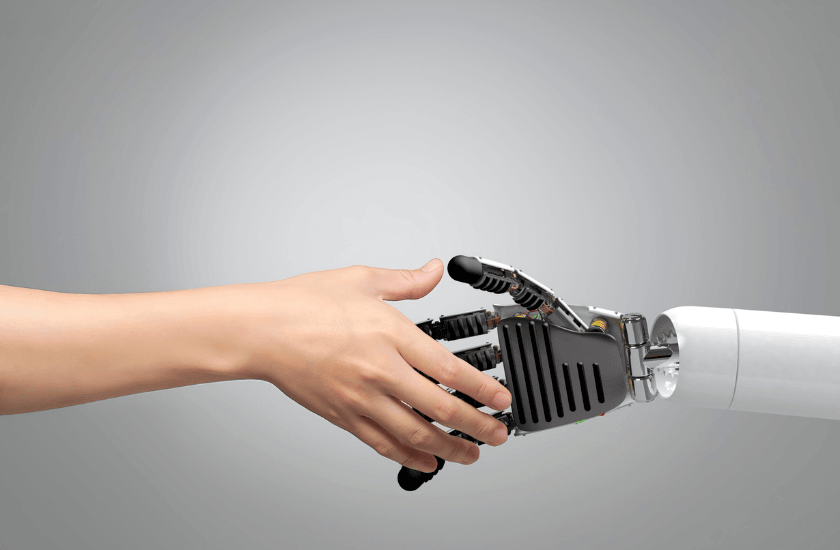
AI does not replace human expertise; rather, it enhances it. When AI and human capabilities are combined, AI performs the heavy lifting of data processing and analysis, while humans validate assumptions, apply context, and provide the intuition that AI lacks. This collaborative approach leads to faster, smarter, and more confident decisions. The concept of “Superagency,” where AI empowers individuals to supercharge their creativity and productivity, is highly relevant for SMEs. This reframes AI not as a threat to jobs, but as a powerful assistant that augments human capabilities. The data clearly shows AI handling repetitive tasks while humans focus on human-centric or high-impact work. This collaborative model is key to maximizing AI’s benefits without alienating employees. SMEs should focus on training their existing workforce to effectively collaborate with AI tools, identifying tasks where AI can assist rather than replace, thereby fostering a culture of “human-in-the-loop” efficiency.
Your Next Step in AI Transformation
This part has illuminated the diverse and impactful applications of technology across critical SME functions, from supercharging marketing and sales to revolutionizing web and graphic design, and streamlining operations through platforms like monday.com. It is clear that technology is accessible and designed to augment human capabilities, not replace them. The key lies in understanding how to integrate these powerful tools strategically to unlock their full potential.
Ready to explore how these trends can specifically benefit your business? Contact us today for a personalized consultation. We can help identify the most impactful applications tailored to your SME’s unique needs, guiding you towards a more efficient, innovative, and profitable future.
For more insights into technology applications in SMEs, consider exploring how Ai can streamline operations and enhance decision-making.
Resources: UNU Merit | Nature | Columbia Business School |