The recent announcement from the New Mexico Economic Development Department and Pacific Fusion marks a pivotal moment, not just for Albuquerque, but for the global pursuit of clean energy and fusion energy. The memorandum of understanding to pursue a potential $1 billion research and development facility in the state is far more than a local news item; it represents a significant stride in the high-stakes race to harness the power of the stars.
This initiative marks a significant commitment to advancing fusion energy technologies.
By leveraging local expertise, New Mexico aims to become a leader in fusion energy development.
Pacific Fusion, a company founded in 2023, is poised to build directly on breakthrough innovations originating from Sandia National Laboratories. Its ambitious vision is to deliver what it describes as “the world’s most affordable on-demand power source”. New Mexico emerges as a natural fit for such a groundbreaking endeavor, boasting a rich “legacy of applied physics innovation, deep talent pool, and business-friendly environment”. This connection to Sandia’s Z Machine and New Mexico’s long-standing expertise in advanced physics indicates that the state is not merely attracting a new industry but is evolving its existing capabilities. This deep historical foundation offers a robust platform for future growth and a distinct competitive advantage, building on decades of prior investment and established infrastructure, all contributing to the state’s goal of advancing fusion energy.
The Future of Fusion Energy: The Sun’s Power, Harnessed in the Desert
Fusion energy, the very process that powers the sun and stars, has long been considered the “holy grail” of clean energy. Ultimately, the goal is to unlock the full potential of fusion energy for future generations. As efforts in fusion energy progress, global collaboration will be essential. Investors are increasingly recognizing the potential returns from fusion energy breakthroughs.
Its allure lies in its potential for a “limitless supply of on-demand power” that is inherently “clean” and “safe”. The primary objective for Pacific Fusion’s proposed Demonstration System is to prove a critical milestone known as “net facility gain.” This means producing more energy from a fusion reaction than the total energy stored in the system. This objective directly addresses the fundamental challenge in fusion research: achieving a net energy output. Consequently, Pacific Fusion’s project is a high-stakes scientific endeavor, focusing on proving a foundational principle rather than immediate commercial power generation. The economic benefits, while substantial, are primarily tied to this research phase and the potential for future commercialization.
The pursuit of fusion energy is a global marathon, with major players including the European Union, the USA, Russia, Japan, and rapidly advancing programs in China. While significant technical challenges persist, experts generally agree that fusion energy could become commercially viable by the 2040s. Projections suggest that first-of-a-kind plants could be available by 2035, with costs falling significantly as deployment scales up, reaching 10th-of-a-kind cost levels by 2050 and 100th-of-a-kind by 2065. This long-term perspective is essential for understanding the project’s true impact.
These investments could significantly enhance New Mexico’s role in fusion energy research. The fusion energy sector’s growth aligns with the state’s broader clean energy goals.
The substantial private capital raised by Pacific Fusion—over $900 million from leading investors like General Catalyst and Breakthrough Energy Ventures since its founding in 2023 —reflects a broader trend. Private fusion companies globally have raised over $9 billion, signaling a rapid acceleration of investment in this field. This surge suggests increasing confidence in fusion’s eventual commercial viability, even as complex engineering and scientific hurdles remain.
Such a supportive ecosystem is vital for fostering innovations in fusion energy.
Table 1: The Promise of Fusion: Key Milestones & Timeline
| Milestone/Projection | Description |
| National Ignition Facility (NIF) Breakthrough (2022) | First experiment to achieve “ignition,” producing more energy from a fusion reaction than the energy injected to start it. |
| Pacific Fusion’s “Net Facility Gain” Goal | Aim to produce more energy from a fusion reaction than the total energy stored in the system, a critical step towards carbon-free electricity. |
| First-of-a-Kind Commercial Plants | Projected availability by 2035. |
| Commercial Viability | Most experts agree fusion energy could become commercially viable by the 2040s. |
| Cost Reductions (10th-of-a-kind) | Attainable by 2050. |
| Significant Cost Reductions (100th-of-a-kind) | Attainable by 2065. |
The state’s focus on fusion energy is integral to its long-term economic strategy. Moreover, the ripple effect of fusion energy investments can enhance regional economies.
New Mexico’s Legacy and Strategic Blueprint
New Mexico’s deep scientific roots are a cornerstone of its appeal. Sandia National Laboratories, a national leader in applied physics, has been at the forefront of fusion research since the 1970s, with its Z Machine evolving from defense applications to energy research. This multi-decade commitment underscores Sandia’s profound and sustained engagement in fusion, providing a robust historical and technical context for Pacific Fusion’s decision to locate in the state. Sandia’s ongoing research also extends to both magnetic and inertial confinement fusion, including work on plasma-material interactions and the tritium fuel cycle, indicating a comprehensive expertise that can facilitate future collaborations.
The Pacific Fusion project aligns perfectly with New Mexico’s broader economic development strategy. The state’s 2024-25 strategic economic plan, “Empower and Collaborate: New Mexico’s Economic Path Forward,” explicitly aims to diversify the economy away from its traditional reliance on natural resource extraction. A key component of this strategy involves investing fossil fuel revenues into public assets and capacity, particularly in clean energy and advanced technologies.
This alignment with federal strategies for fusion energy could bolster funding opportunities.
Investments in fusion energy are seen as crucial to meeting future energy demands.
Addressing these challenges head-on will be vital for the success of fusion energy initiatives.
Public engagement and education about fusion energy are essential for its acceptance.
New Mexico’s institutional support for advanced technology is robust. The Office of Science & Technology (OSST) leads programs that encourage the growth and relocation of tech-based industries, offering competitive grants ranging from $50,000 to $1,000,000 for advanced energy and quantum technologies. This demonstrates tangible financial and programmatic support, moving beyond mere rhetoric. Furthermore, the New Mexico Clean Energy Resilience and Growth (NM CERG) cluster, funded by the EDD, supports clean energy technology companies. NM CERG’s inclusive definition of “clean energy,” encompassing nuclear technologies, is particularly relevant, positioning fusion energy not as an isolated venture but as a natural fit within New Mexico’s existing, comprehensive clean energy strategy, leveraging its historical nuclear expertise.
Ultimately, the vision for fusion energy in New Mexico is one of innovation and sustainability.
The future of fusion energy will depend on continued investment and community collaboration.
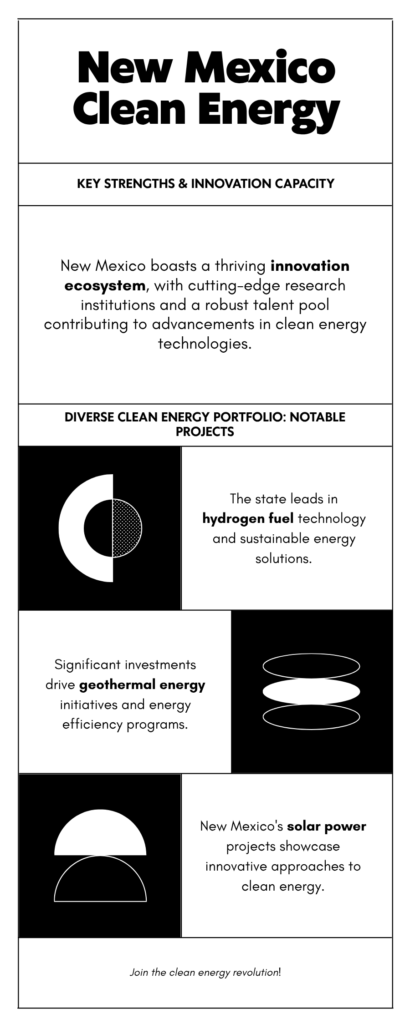
New Mexico’s commitment to fostering a vibrant innovation ecosystem is evident in its national rankings and diverse portfolio of successful projects. The state is ranked 1st nationally in non-industry investment in research and development and 2nd in high-tech jobs. This quantifiable leadership, coupled with the presence of three national research laboratories, three research universities, and over 20 venture capital firms, creates a fertile ground for technological advancement. This established network of national laboratories, universities, and a burgeoning private sector exemplifies the collaborative model the U.S. aims for in fusion commercialization, positioning New Mexico as a strategic hub for advanced energy development.
Table 2: New Mexico’s Clean Energy & Tech Ecosystem Snapshot
| Category | Details |
| Innovation Capacity Ranking | Top 10 nationally. |
| Non-Industry R&D Investment | Ranked 1st nationally. |
| High-Tech Jobs Ranking | Ranked 2nd nationally. |
| National Research Laboratories | Home to three (Sandia, Los Alamos, etc.). |
| Research Universities | Home to three. |
| Venture Capital Firms | Over 20 geared towards tech startups. |
| Notable Clean Energy Projects/Companies | Maxeon Solar Technologies (1,800 jobs), Ebon Solar (900 jobs), Star Scientific (green hydrogen R&D), Santa Teresa Solar (150MW, 600MWh battery), XGS Geothermal (150MW with Meta), Pajarito Powder (electrocatalysts for green hydrogen). |
Beyond fusion, New Mexico has attracted significant investments in other clean energy sectors. Maxeon Solar Technologies is building a 1.9 million-square-foot complex in Albuquerque, expected to employ up to 1,800 people, making it the first commercial-scale solar cell manufacturer in the U.S.. Ebon Solar is investing nearly $1 billion in a neighboring solar cell manufacturing facility, bringing 900 jobs. Australia-based Star Scientific chose New Mexico for its first North American green hydrogen research and development campus. These tangible successes demonstrate a proven track record and a vibrant, expanding clean-tech sector, reinforcing that Pacific Fusion’s potential arrival is part of a larger, positive trend.
The Ripple Effect: Economic Transformation and Challenges
The Pacific Fusion project promises a significant economic ripple effect. Beyond the initial $1 billion capital investment, it is expected to create over 200 long-term jobs and hundreds more in construction, alongside workforce development programs and regional economic activity. This investment arrives at a critical juncture, as rising electricity demand from sectors like artificial intelligence, electric vehicles, and reshoring manufacturing necessitates new, reliable, and clean power sources. This connection between burgeoning electricity demand from advanced industries and the necessity for new, reliable, clean power sources like fusion creates a compelling economic argument for fusion, extending beyond purely environmental considerations. It positions fusion as a critical enabler for future economic growth and competitiveness.
The project will also stimulate the development of a specialized supply chain, attracting and growing related businesses. Effective supply chain management is crucial for complex technological endeavors, fostering better collaboration, improved quality control, and higher efficiency across the region.
While large-scale R&D investments like Pacific Fusion’s are known to yield long-term productivity gains and improve living standards, their impact on local housing markets can be complex. Research indicates that housing markets are largely local, and new developments can either increase affordability through supply or, conversely, raise rents by attracting wealthier households and new amenities. This suggests that New Mexico’s commitment to building “a future-focused economy that benefits all New Mexicans” will require proactive local policy responses, potentially including addressing land use policies, to ensure equitable housing outcomes and broad distribution of economic benefits.
New Mexico’s economic strategy aligns seamlessly with the broader U.S. federal industrial strategy for “regional economic transformation” through investments in clean energy and advanced industries. This alignment strengthens the project’s strategic importance and potential for sustained federal support, as it contributes to a national push for higher-value industries and better jobs across the country.
Navigating the Path Ahead: Challenges and Public Trust
The path to commercial fusion energy is not without its challenges. Significant scientific and engineering hurdles remain, including complex plasma physics and the development of materials capable of withstanding extreme fusion conditions for decades. There is currently no facility where these materials can be fully tested. Furthermore, challenges related to tritium delivery and the overall fuel cycle must be addressed for long-term viability. These are not minor issues but fundamental scientific and engineering frontiers that require sustained research and collaboration across the global fusion community. Pacific Fusion’s success, while a major step, is part of this larger, ongoing global scientific and engineering endeavor, requiring continued innovation across multiple fronts.
Beyond the technical, environmental considerations and public perceptions are crucial for securing “social license” for fusion facilities. While fusion promises significant environmental benefits like zero CO2 emissions and no long-lived radioactive waste, a comprehensive understanding recognizes the need for new infrastructure and policies to manage low-level waste and tritium, and to address concerns about critical mineral dependencies. Successfully integrating such a facility into a community requires proactive, transparent public engagement to ensure that local concerns regarding land and water use, localized socioeconomic impacts, and decommissioning are addressed. Connecting the facility’s design to community history and ensuring transparency and access are vital for building public trust and securing acceptance for fusion technologies.
All Eyes on the Fusion Future
The potential siting of Pacific Fusion’s $1 billion research facility in Albuquerque is a powerful testament to New Mexico’s unique blend of scientific heritage, strategic foresight, and a burgeoning clean-tech ecosystem. It represents not just a substantial capital investment and the creation of high-quality jobs, but a critical step in the global pursuit of limitless, clean energy.
By leveraging its national laboratories as foundational assets, fostering a diverse clean energy portfolio that extends beyond fusion to solar, geothermal, and green hydrogen, and aligning its economic development goals with national strategic priorities, New Mexico is positioning itself as a pivotal player in the advanced energy revolution. The state is actively shaping its own economic future, moving decisively towards diversification and contributing significantly to a sustainable global energy landscape. The ongoing ability to navigate the complex challenges of infrastructure development, housing affordability, and transparent public engagement will ultimately determine the full extent of this transformative journey.
For more information about NM’s economic development, go to NMEDD or Contact Us.