
The Council for Community and Economic Research (C2ER) just released its Quarter 2, 2026 Cost of Living Index. The Rio Rancho cost of living number tells a clear story for anyone comparing sites across the Southwest. Sandoval County posted a composite score of 86.4. This is the lowest reading of any tracked market in New Mexico this quarter, including Albuquerque and Las Cruces.
What the Number Actually Means
C2ER builds its composite index from six weighted components: Grocery Items, Housing, Utilities, Transportation, Health Care, and Miscellaneous Goods and Services. The average of every participating place, urban and rural, is set at 100. Any score under 100 means a market runs cheaper than the national panel. Housing carries the heaviest weight in the formula, close to 30 percent. Thus, it moves the composite score more than any other line item.
It’s worth noting that C2ER’s own guidance says the index is a snapshot of relative price levels at one point in time, not a measure of inflation. The mix of participating cities shifts every quarter. With that in mind, a single quarter’s score is best read as a comparison of where a place stands against its peers right now, which is exactly what matters for site selection.
Sandoval County Undercuts Its Own Metro
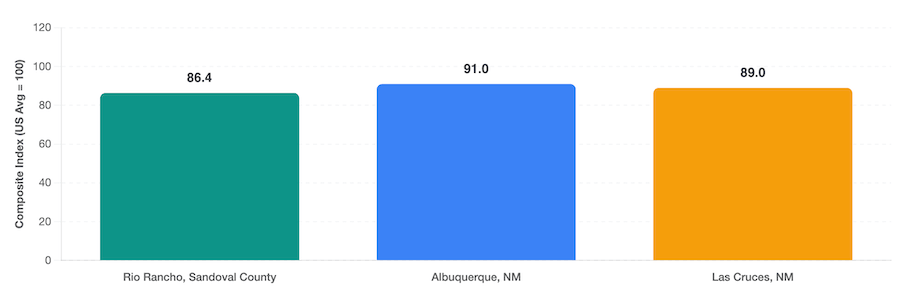
Line up the three New Mexico markets side by side and the result is a little surprising. Albuquerque came in at 95.1, Las Cruces at 89.1, and Sandoval-Rio Rancho at 86.4. Las Cruces sits nearly 300 miles south, near the border, and has long carried the reputation as the state’s budget option.
Rio Rancho, by contrast, sits inside the Albuquerque metro area. It is wired to the same interstate corridor, the same airport, and a much deeper labor pool. Yet it still runs cheaper on paper than Las Cruces and nearly nine points below Albuquerque proper. Metro access at a smaller market price is not the usual pattern. This gap deserves a second look from anyone building a site short list.
The Housing Gap Does Most of the Work
Sandoval’s housing sub-index reads 75.2 this quarter against Albuquerque’s 89.9. This creates a spread of close to 15 points on the single component that makes up almost a third of the total score. C2ER’s own comparison formula turns that spread into a real number for compensation planning.
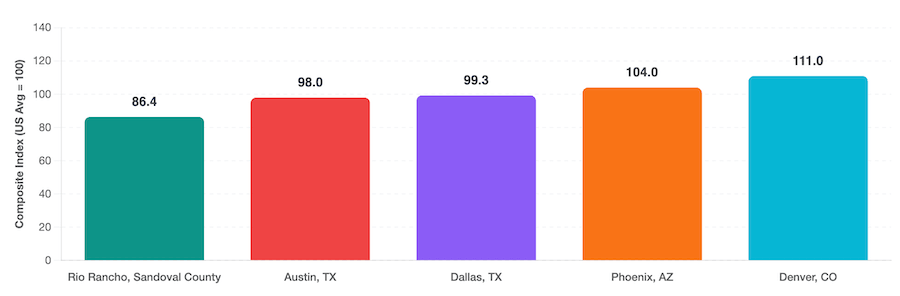
Using the composite scores, an employee moving from Rio Rancho to Denver (109.0) would need roughly 26 percent more after-tax pay to hold the same standard of living. The same move to Reno (105.4) runs about 22 percent, to Phoenix (104.1) about 20 percent, to Salt Lake City (101.4) about 17 percent, and to Austin (98.0) about 13 percent. These aren’t marketing figures; they come straight out of the math C2ER publishes in every issue.
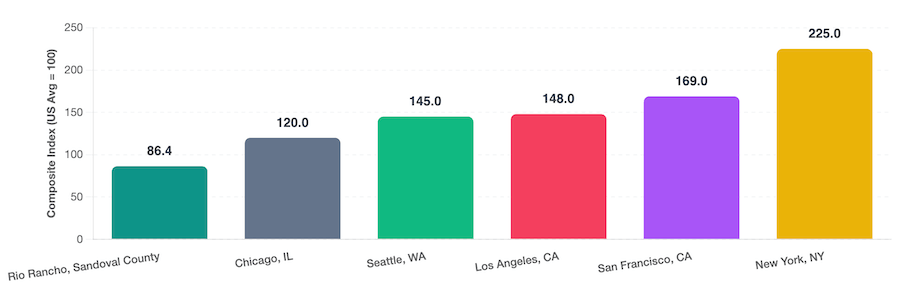
For a corporate site selector, that spread is not a lifestyle footnote. It is a line item in every relocation package and every compensation study run before a facility opens. A lower cost floor lowers the total comp a company has to offer to pull talent from a higher-cost hub. This reduces structural overhead before the first shift ever clocks in.
For an operation already managing margin compression on the production side, payroll is one of the few levers still available. Geography does part of that work automatically. That is capital efficiency showing up on the labor side of the balance sheet rather than the equipment side.
Utilities and Transportation Hold Steady
Sandoval’s utilities index, 82.1, lands almost even with Albuquerque’s 82.2, and both sit well under the national mark. That matters for any operation with real power draw, from a precision machine shop to a data center evaluating power and fiber capacity.
Transportation reads 94.0, close to the national average, reflecting local fuel and maintenance costs rather than any added drag from commuting distance or highway access. For companies weighing transport latency to Interstate 25 and Interstate 40, or to the Albuquerque International Sunport for freight and travel, Sandoval County offers big-market road and air access without a big-market utility bill.
A Quiet, Consistent Trend, Not a One-Quarter Blip
Quarter-over-quarter change should be read carefully. The panel of participating cities is not identical from one release to the next. With that caveat in place, Sandoval’s composite moved from 87.2 in Q1 2026 to 86.4 in Q2. Its housing sub-index moved from 79.8 to 75.2, while both Albuquerque and Las Cruces ticked slightly upward over the same stretch.
Read on their own terms, those two data points describe a market holding, and even widening, its relative position rather than riding a temporary swing. This is the pattern site selectors actually look for: operational endurance built into the cost structure itself, not a single quarter’s discount.
Understanding the Rio Rancho Cost of Living
Castelion’s Project Ranger, a 1,000-acre solid rocket motor manufacturing campus, broke ground earlier this year. It has a projected $650 million impact over the next decade. It chose Sandoval County for reasons that go beyond incentives alone.
The Rio Rancho City Center and the Tamaya Ventures Site 5, both carrying the state’s site readiness designation, cut the due diligence timeline before a company ever breaks ground. This improves speed-to-market for the next project in line. But physical site readiness only gets a company to groundbreaking faster. The cost of living numbers are what keep the payroll line sustainable for the ten or twenty years after the ribbon is cut.
The region’s long run as home to Intel’s Rio Rancho operations has also built a technical workforce with a strong location quotient in advanced manufacturing and skilled trades. This is the kind of labor pool that Castelion, and the aerospace and defense sector generally, is actively recruiting against right now.
The Key Takeaway
For a corporate real estate team or a private equity group underwriting a Southwest expansion, a composite cost index is a starting point, never the whole picture.
However, an 86.4 next to Denver’s 109.0, Phoenix’s 104.1, and even Las Cruces’s 89.1 makes a straightforward case. Sandoval County, and Rio Rancho specifically, still competes hard on cost while sitting inside a metro area with the workforce, infrastructure, and air access of a much larger city.
Gaps like this tend to close once more companies notice them. This is exactly why this quarter’s numbers belong in every regional site selection conversation happening right now.