
The regional race for advanced manufacturing and technology market share is increasingly determined by a single financial reality: the cost of operational endurance. As Tier 1 metro areas face historic overhead spikes, western site selectors are re-evaluating their geographic footprints. The Q1 2026 Cost of Living Index (COLI) highlights a stark divergence between traditional technology centers and emerging hubs. For corporations looking to maximize capital efficiency, the latest data establishes the New Mexico Tech Corridor—specifically Sandoval County and the City of Rio Rancho—as the premier high-value alternative in the Mountain West. Additionally, accessing Rio Rancho Business Resources can significantly enhance operational strategies.
In the tech sector, inflation has squeezed margins across real estate, industrial energy, and labor retention. Competing regional hubs have seen their cost structures inflate past the point of sustainable growth. The data shows that Sandoval County provides an immediate relief valve for these pressures. By pairing lower structural costs with an exceptionally dense, technical talent pool, the region changes the math on corporate expansions. Utilizing these distinct regional advantages allows incoming enterprises to convert baseline operational savings directly into rapid research, development, and scaling capacity.
The Q1 2026 Cost Comparison: Real Estate and Baseline Living Costs
The baseline cost of living directly impacts corporate payroll efficiency. When employees face exorbitant housing and consumer costs, employers must artificially inflate wages just to maintain standard retention. The Q1 2026 COLI data demonstrates the stark structural premium required to operate in competing western markets compared to the affordable baseline found within the New Mexico Tech Corridor.
Utilizing Rio Rancho Business Resources can further streamline processes and bolster business growth in the region.
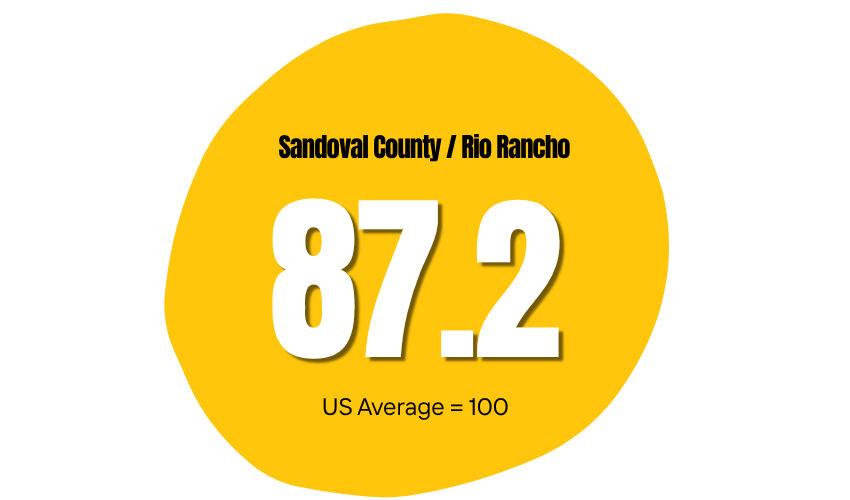
The index benchmarks the national average at 100. Markets like Denver, Phoenix, and Salt Lake City now carry significant cost premiums, particularly in housing and industrial utilities.
Q1 2026 Cost of Living Index Comparison
| Metro Area / Region | Composite Index | Housing Cost Index | Utilities Index | Transportation Index |
| Rio Rancho / Sandoval County | 87.2 | 74.1 | 83.5 | 89.2 |
| Austin, TX | 102.4 | 111.2 | 95.8 | 98.2 |
| Phoenix, AZ | 108.6 | 119.4 | 104.2 | 107.1 |
| Salt Lake City, UT | 111.3 | 124.7 | 96.1 | 103.4 |
| Denver, CO | 114.8 | 132.5 | 98.7 | 105.9 |
The housing index presents the most immediate point of divergence. Denver’s housing costs sit 32.5% above the national average, while Salt Lake City carries a 24.7% premium. In contrast, Rio Rancho remains 15.9% below the national average. This deep affordability functions as a foundational tool for permanent recruitment. It allows companies to offer competitive, high-value compensation packages that secure a higher standard of living for employees without bloating the corporate balance sheet.
What Low Cost of Living Translates to for Businesses
For expanding enterprises, a sub-100 cost of living composite index creates an operational arbitrage opportunity. Every dollar saved on structural real estate and baseline utility overhead is capital that can be reinvested into advanced production hardware, automated systems, and market expansion. In high-overhead markets like Phoenix or Denver, capital is consumed heavily by land acquisitions and lease premiums before a facility even begins production.
Furthermore, corporate site selectors must look at the long-term stability of utility costs. Data centers and advanced manufacturing facilities require immense, uninterrupted power and water infrastructures. The Q1 2026 utility index for Sandoval County sits at 87.2, well below Phoenix’s 104.2. This structural advantage gives industrial operations long-term cost predictability. This fiscal predictability is enhanced by specialized Rio Rancho business resources, including targeted industrial revenue bonds (IRBs) and local economic development act (LEDA) funds, which shield expanding operations from sudden capital drains.
The Intersection of Labor Density and Cost Efficiency
The true competitive advantage of Sandoval County emerges when low structural overhead intersects with a highly skilled workforce. A common misconception in economic development is that a lower cost of living implies a less sophisticated labor pool. The New Mexico Tech Corridor systematically disproves this assumption. Due to the multi-decade presence of foundational anchors like Intel, the region features an exceptionally high concentration of specialized engineering and technical talent.
Data from the New Mexico Department of Workforce Solutions illustrates the density of this technical talent pool. The Albuquerque Metropolitan Statistical Area (MSA), which feeds directly into Rio Rancho, maintains some of the highest concentrations of precision manufacturing and engineering talent in the southwest.
High-Value Technical Wages & Talent Concentration (Albuquerque MSA)
| Specialized Occupation | Median Hourly Wage | Median Annual Salary | Regional Location Quotient |
| Architecture & Engineering Managers | $94.34 | $196,230 | 1.85 |
| Electrical Engineers | $71.65 | $149,040 | 2.12 |
| Aerospace Engineers | $69.37 | $144,280 | 1.78 |
| Mechanical Engineers | $58.42 | $121,520 | 1.45 |
The Location Quotient (LQ) is a critical metric for site selectors. An LQ of 1.0 represents the national average concentration for an occupation. The region’s LQ of 2.12 for electrical engineers means Sandoval County and its immediate surroundings possess more than twice the national average density of this specialized labor force.
When a company builds a facility in Rio Rancho, they gain immediate access to an elite engineering pool without facing the fierce, margin-killing talent poaching wars characteristic of Silicon Valley, Denver, or Austin. Employees stay longer because their compensation goes further in a market where housing costs are controlled and stable.
Reversing Brain Drain in New Mexico Through Industrial Synergy
This powerful combination of economic affordability and structural readiness is the primary engine for reversing the brain drain in New Mexico. Historically, highly trained graduates from the University of New Mexico (UNM) and Central New Mexico Community College (CNM) looked out of state for competitive tech careers. Today, the arrival of advanced defense innovators like Castelion and the expansion of semiconductor infrastructure are completely flipping that script.
By providing a low-overhead environment where tech firms can scale fast, Sandoval County creates the sustainable, high-wage employment infrastructure required to retain top-tier local graduates. Young engineers and computer scientists no longer have to choose between a sophisticated career and an affordable lifestyle. They can design hypersonic systems or advanced microelectronics on the mesa while enjoying a cost of living that allows them to purchase homes and build equity early in their careers.
Partner with the Sandoval Economic Alliance
The Q1 2026 cost of living data proves that corporate growth does not require exorbitant operational premiums. Capital efficiency, infrastructure readiness, and labor density coexist sustainably on the northern mesa. The City of Rio Rancho and Sandoval County offer a clear runway for firms that refuse to compromise between margin health and technical capability.
The Sandoval Economic Alliance functions as your strategic partner and data coordinator on the ground. By utilizing our centralized property and economic research systems, we provide incoming site selectors with clean data and streamlined support. We invite you to explore Our Services and review our comprehensive regional data sheets. Let us show you how the Sandoval Difference can transform your operational velocity and accelerate your next expansion.
Data Sources for Verification
- Cost of Living Data & Index Metrics:
- Labor Statistics and Wage Data:
- Regional High-Tech Expansion Facts: