
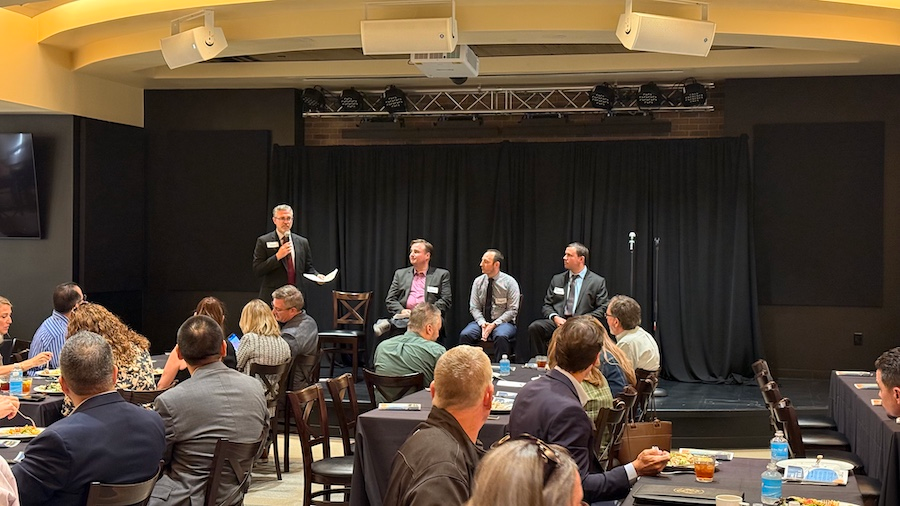
Editor’s Note: The following article is a summary of insights from an expert panel discussion held at the Sandoval Economic Alliance (SEA) quarterly Partner Luncheon on September 16, 2025 The panelists included Steven Bartlett, Manager at CLA (CliftonLarsenAllen LLP); Michael O’Donnell, PhD, JD, Director of the Bureau of Business and Economic Research at UNM; and Reilly S. White, PhD, Associate Dean and Professor of Finance at UNM’s Anderson School of Management. Our President and CEO, Fred Shepherd, was the moderator.
If there is a single word to describe the economic outlook following the passage of the “One Big Beautiful Bill” (OBBB), it is uncertainty. The sweeping piece of federal legislation is poised to put the American economy on the cusp of a fundamental shift, with analysts and business leaders bracing for a period of profound unpredictability. The bill’s ultimate consequences are difficult to forecast due to its massive scale and the complexity of its interconnected provisions. In this context of uncertainty, it is crucial for businesses to adapt and innovate.
A Test of Fiscal Sustainability
At the heart of the debate is the bill’s fiscal sustainability. The projection that it will add $3 trillion to the national deficit raises serious concerns, especially given that the current national debt already exceeds $34 trillion. An addition of this magnitude would significantly alter the nation’s fiscal trajectory and inevitably increase its debt service costs, meaning more taxpayer money would be spent on interest payments rather than on public services or investments.
This fiscal pressure is compounded by external factors like the threat of a potential government shutdown, which adds another layer of instability. For the business community, this environment makes long-term planning nearly impossible. Uncertainty itself functions as a cost to business and investment; when companies cannot reliably forecast tax liabilities, consumer demand, or supply chain costs, they tend to delay hiring and capital expenditures. This difficult operating environment suggests an economic slowdown may be on the horizon.
Recent volatility in Gross Domestic Product (GDP) may be an early sign of this disruption. In the first quarter of 2025, many companies, anticipating the bill’s new tariffs, rushed to import goods, which paradoxically led to a 0.5% decrease in GDP. In the second quarter, as this stockpiling ceased and consumer spending ticked up, GDP jumped by 3.3%. This swing does not reflect organic growth but rather a market reacting to massive, impending policy shifts.
A Divergent Impact on Households
The bill’s effects will be felt nationwide but are expected to land unevenly across different income brackets. The legislation includes tariffs that will almost certainly make a wide range of consumer goods more expensive. Studies on previous rounds of tariffs, such as those in 2018, have consistently shown that the costs are passed on almost entirely to domestic consumers and businesses, leading to inevitable price hikes for households.
For some, the impact may be muted initially. Communities with higher average incomes, like Sandoval County with its household average of approximately $84,000, are relatively well-positioned to absorb these initial shocks. However, there are deep concerns for lower-income families. According to recent Federal Reserve reports, nearly one-third of American adults cannot cover an unexpected $400 expense, making them exceptionally vulnerable to even minor increases in the cost of living. The legislation is expected to hit these lower-income brackets particularly hard.
While the bill includes provisions such as eliminating taxes on tips and overtime pay, many low-wage workers may not earn enough in those categories to see a meaningful benefit. This could create a ripple effect, as reduced spending by this large demographic could lead to layoffs. The financial burden may then fall to state governments to provide an enhanced social safety net.
Healthcare and State-Level Burdens
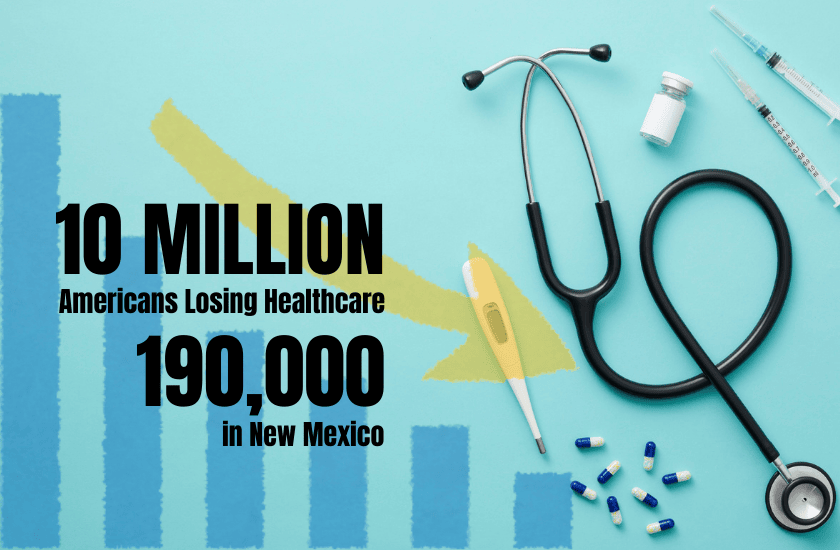
Perhaps one of the most significant aspects of the OBBB is its impact on healthcare. Recent analyses project that an estimated 10 million Americans could lose their health insurance, with approximately 190,000 of them in New Mexico alone.
This is tied to changes in Medicare and Medicaid funding, which are projected to create a $260 million shortfall for the State of New Mexico. The situation is especially critical given that over 900,000 New Mexicans—more than 40% of the state’s population—rely on Medicaid for their health coverage. Compounding this financial strain is a new federal mandate requiring the state to verify Medicaid eligibility twice a year instead of annually. This would be a monumental undertaking, requiring a massive IT infrastructure project that history shows can run into the hundreds of millions of dollars for state governments.
A Potential Boon for Manufacturing
Despite the sobering forecast, one sector may stand to benefit: manufacturing. The bill’s emphasis on domestic production could invigorate American manufacturing. This is a significant factor in New Mexico, where the manufacturing sector contributes over $5 billion to the state’s GDP annually and provides tens of thousands of jobs.
This could be a silver lining for regions with a strong industrial base. Sandoval County, for instance, has the highest concentration of manufacturing in the state and is well-positioned to capitalize on this shift. This presents a strategic opportunity for economic development agencies to attract new investment.
Even so, the path forward is complex. Consumer behavior will likely change as buyers navigate new rules; for example, purchasing a car may soon involve calculating the ratio of “Made in USA” components to minimize tariffs. Further complicating New Mexico’s outlook is its workforce. The state has one of the highest per capita concentrations of federal employees in the nation, with federal jobs accounting for nearly 10% of all non-farm employment. A potential government shutdown or federal budget shifts would disproportionately impact the state’s economy, adding one final, potent layer to the cloud of uncertainty.
Shape Our Economic Future
Navigating complex economic shifts is at the core of the Sandoval Economic Alliance’s mission. To be part of the conversation and help create opportunities in our community, business and civic leaders are invited to learn more about becoming an SEA partner.