
The Dawn of the AI-Powered SME
Artificial intelligence is no longer a futuristic concept reserved for global corporations and tech giants. It has arrived, and its transformative power is actively reshaping the competitive landscape for businesses of all sizes.
Small and medium-sized enterprises (SMEs) stand at a pivotal moment, where embracing it is not merely an option for incremental growth but is rapidly becoming a fundamental necessity for sustained competitiveness and even survival.
This three-part series aims to demystify this technology for SMEs, providing a clear understanding of its urgent need, practical applications, and a strategic roadmap for successful implementation. The goal is to equip business leaders with the knowledge to navigate this new era and unlock unprecedented efficiencies and growth.
The Shifting Business Landscape: The Economic Tidal Wave
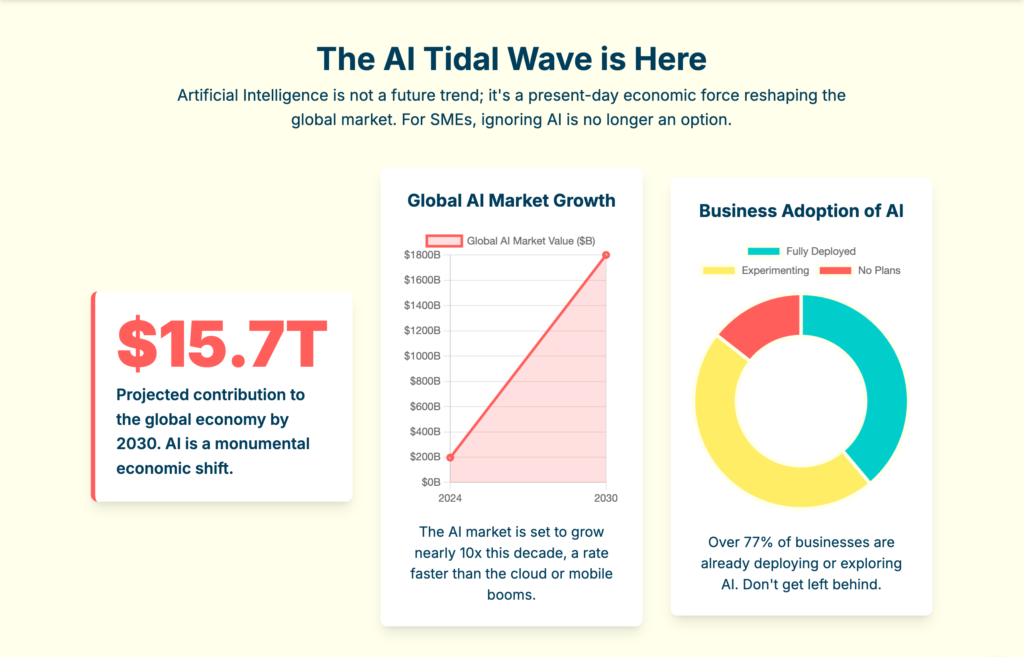
The economic impact of this technology is profound and far-reaching, signaling a monumental shift in global commerce. Reports indicate that it is projected to contribute a staggering $15.7 trillion to the global economy by 2030, according to PwC.
This figure alone underscores the immense economic power it is set to wield. The global market for this technology, valued at $196.6 billion in 2024, is forecasted to expand exponentially, surpassing $1.8 trillion by 2030.
This expansion is driven by increasing enterprise adoption, rising consumer interactions, and public-sector integration. The projected Compound Annual Growth Rate (CAGR) of 35.9% between 2025 and 2030 for this market is particularly telling. This rate of growth is faster than even the cloud computing boom of the 2010s and the mobile app economy of the early 2010s.
The sheer scale of this projected economic contribution and market growth indicates that this technology is not a fleeting trend but a fundamental, irreversible transformation of the global economy.
For SMEs, this means that ignoring it is akin to ignoring the internet in the early 2000s; it represents a guaranteed path to obsolescence. The market forces driving adoption are too strong to resist, implying that businesses that hesitate risk being outmaneuvered by competitors who are already leveraging it for efficiency and innovation.
This underscores the critical “imperative” behind integrating it into business operations.
This technology and Machine Learning (ML) are transforming diverse sectors at an unprecedented speed.
In finance, fraud detection tools monitor billions of transactions in real-time, with JPMorgan Chase reportedly saving over $150 million annually through enabled systems.
The retail and e-commerce sectors benefit from predictive analytics, which can forecast customer purchasing habits with a predicted 90% accuracy, enabling dynamic pricing and customized inventory management.
In manufacturing, predictive maintenance systems improve equipment lifetime by up to 60% and reduce downtime, saving millions in operational costs while enhancing worker safety.
Even healthcare is being revolutionized, with diagnostic equipment leading to earlier and more accurate disease detection and predictive analytics reducing hospital readmission rates by over 25%.
The widespread impact of this technology across these vastly different industries demonstrates its versatility and fundamental utility beyond specific tech sectors.
For SMEs, this means that regardless of their industry, it offers applicable solutions. If larger players in these industries are already seeing massive savings and efficiencies, SMEs must adopt it to remain competitive, even if it is on a smaller scale.
Businesses need to identify specific pain points within their operations that it can address, drawing inspiration from these large-scale industry transformations to pinpoint areas where it can deliver tangible value.
Beyond the Hype: Tangible Benefits for SMEs
This technology has rapidly shifted from being merely a buzzword to an integral business tool for small businesses.
This transformation is driven by a range of tangible benefits that directly impact an SME’s bottom line and operational effectiveness.
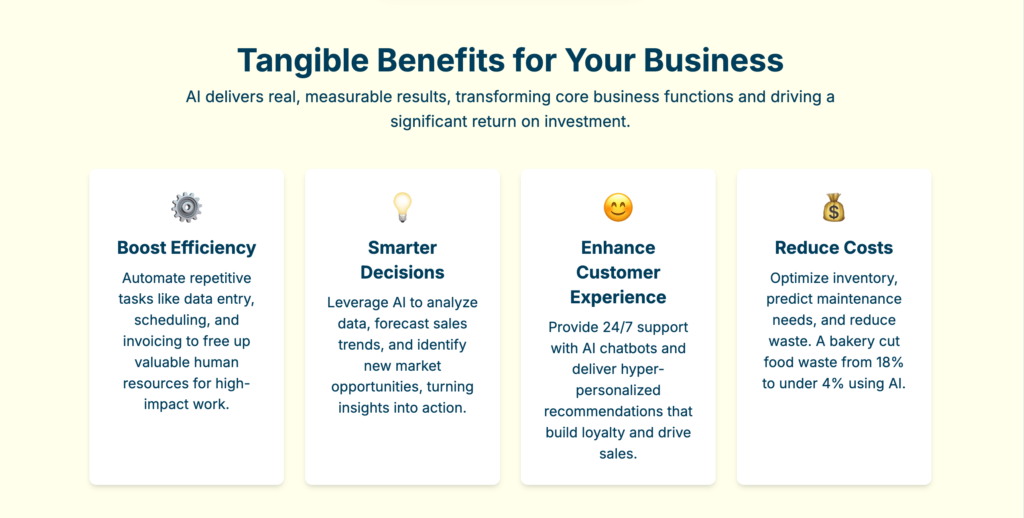
Efficiency and Cost Savings: This technology can significantly improve operational efficiency, directly translating into substantial time and cost savings.
Automating repetitive tasks such as data entry, appointment scheduling, and invoice processing reduces operational costs and frees up valuable staff time for more high-impact work.
For SMEs, where resources are often stretched thin, the ability to automate these routine tasks directly translates into tangible cost reductions and increased productivity.
This is not about futuristic innovation but about immediate, practical return on investment (ROI).
The lean operational structure characteristic of many SMEs means these efficiency gains can have an even more profound impact on their financial health.
SMEs can achieve quick wins and demonstrate its value internally by prioritizing applications that target high-volume, low-value tasks.
Enhanced Decision-Making: This technology empowers businesses to make more informed strategic decisions.
It can analyze vast amounts of internal business data, identify common themes, compare performance against similar businesses, and pinpoint operational gaps or exploitable advantages.
Furthermore, predictive analytics can forecast demand, optimize pricing strategies, and anticipate customer needs, transforming raw data into actionable insights that support growth.
Improved Customer Experience: Tools are revolutionizing customer service by enabling SMEs to provide more timely and personalized support.
Powered chatbots and virtual assistants can offer 24/7 customer service, answer common questions, and provide personalized assistance, significantly reducing customer waiting times.
Beyond support, it can enhance customer engagement through personalized recommendations and highly targeted advertisements.
Addressing Labor Shortages: In an environment of labor shortages, this technology can help compensate for a lack of skilled labor by automating tasks that would otherwise require human intervention.
In a tight labor market or for small teams, it is not just about cutting costs but about amplifying existing human capacity.
By handling repetitive tasks, it allows the limited human workforce to focus on complex problem-solving, creativity, and building stronger customer relationships, effectively multiplying their output and strategic value.
This is particularly crucial for SMEs that may struggle to attract or retain specialized talent.
SMEs can view it as a tool to empower their current employees, enabling them to achieve more with less, rather than solely as a replacement for human jobs.
The following table summarizes the key benefits of adoption for small businesses:
| Benefit Area | Specific Impact for SMEs | Supporting Data/Source |
| Efficiency | Automate repetitive tasks (data entry, scheduling, invoicing), streamline workflows. | Reduces operational costs , frees up staff time. |
| Cost Savings | Reduce manual effort, optimize resource allocation. | Enables investment in growth areas, saves millions in operational costs (Manufacturing). |
| Decision-Making | Analyze data, forecast trends, identify opportunities/gaps. | Turn data into practical decisions , make better strategic decisions. |
| Customer Experience | 24/7 support, personalized interactions, faster responses. | Chatbots, automated follow-ups, personalized recommendations. |
| Productivity | Eliminate bottlenecks, focus on high-impact work. | 84% of leaders believe AI positively impacts productivity. |
| Competitiveness | Adapt quickly to market changes, compensate for labor shortages. | Stay competitive in times of inflation , build resilient business models. |
Real-World Success: How SMEs Are Already Thriving with This Technology
While some small businesses remain hesitant, the broader trend shows significant adoption across the business landscape. According to Exploding Topics, 35% of businesses have fully deployed it in at least one function, and 42% are actively experimenting or piloting tools. Only a small minority, 13%, have no adoption plans. This indicates that while it is widely recognized and adopted by many businesses, SMEs face unique barriers such as perceived cost, complexity, and risk. This gap represents a significant opportunity for specialized assistance to guide SMEs through these specific challenges. It is important to acknowledge this hesitancy directly and then provide actionable pathways to overcome it, emphasizing that success stories exist and are attainable for SMEs.
Real-world examples demonstrate the transformative power of this technology for SMEs:
- Customer Service: One business transformed its showcase website into a 24/7 sales assistant, leading to a 40% increase in qualified meetings within three months and eliminating manual scheduling tasks for consultants. This illustrates how AI can directly impact lead generation and operational efficiency.
- CRM and Human Resources: Automating onboarding processes saved 2-3 hours of work per new hire for HR and management teams, significantly increasing new employee satisfaction scores. This shows AI’s ability to streamline internal operations and improve employee experience.
- Marketing: An e-commerce business achieved a 15% reduction in customer churn within six months and a 10% increase in customer lifetime value by using AI for predictive churn analysis and better targeting. This highlights AI’s capacity to drive measurable improvements in customer retention and profitability.
- Operations: A law firm successfully doubled its client capacity by implementing an AI-powered document analysis and generation system, which reduced document preparation time by 70% and increased revenue by 65%. This demonstrates AI’s ability to automate core processes and enable significant business expansion.
- Inventory Management: A neighborhood bakery eliminated food waste, decreasing it from 18% to under 4%, and increased profit margins by 22% through the implementation of a simple AI forecasting system. This case exemplifies how even traditional businesses can benefit from relatively simple AI applications focused on specific business problems.
These diverse case studies demonstrate that its value for SMEs is not in broad, complex overhauls, but in targeted applications that solve specific, measurable business problems. This approach makes it less daunting and more accessible. SMEs can achieve significant improvements by focusing on their most pressing operational pain points and exploring how it can provide a focused solution, rather than attempting a large-scale, enterprise-level transformation. This also highlights the need for a strategic partner to help identify these high-impact areas.
Your Journey Starts Now
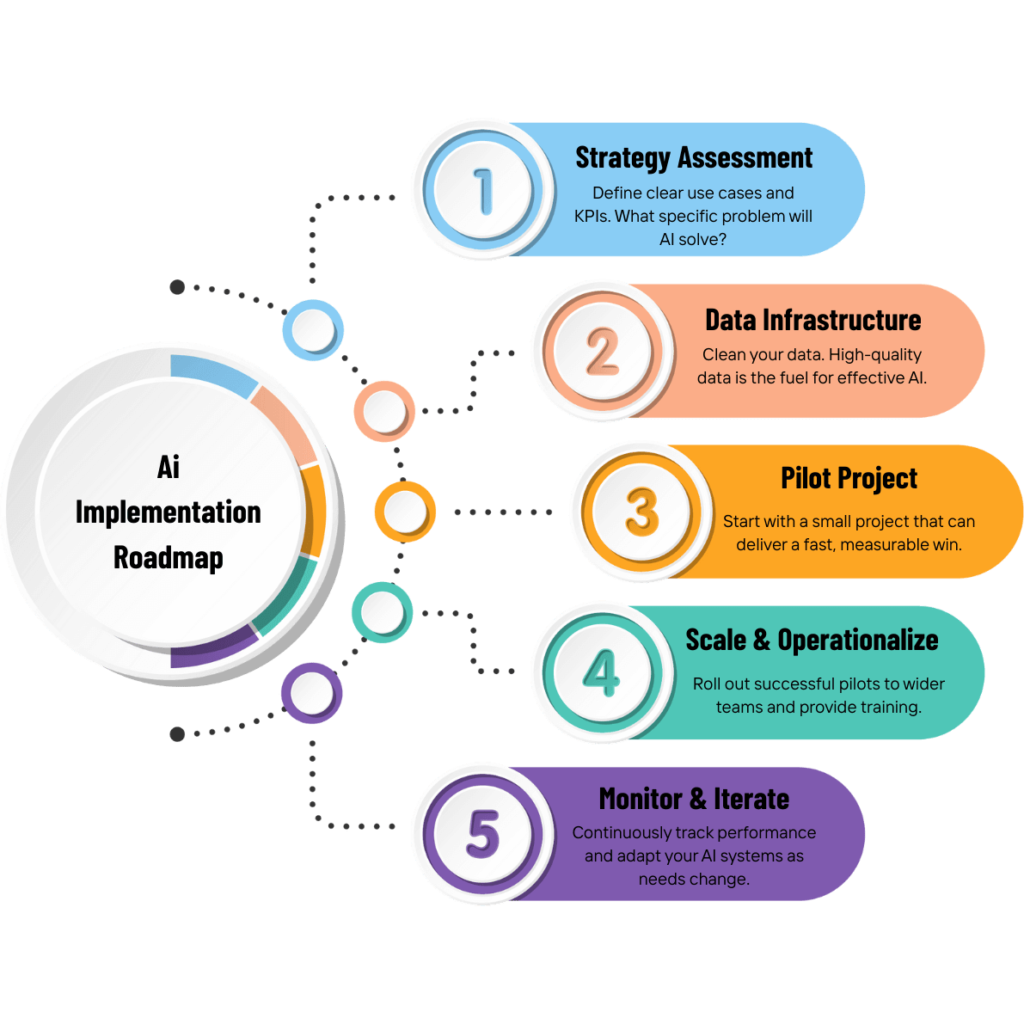
The economic landscape is undeniably shifting towards a powered future. The immense projected growth of the market and its pervasive impact across industries underscore that it is not a luxury but a strategic imperative for SMEs.
From enhancing efficiency and cutting costs to improving customer experiences and making smarter decisions, the tangible benefits are clear.
While some SMEs may feel hesitant due to perceived complexities, numerous real-world examples prove that successful adoption is within reach, particularly through targeted applications that address specific business challenges.
The competitive gap between those embracing it and those lagging is widening. The time to act is now to ensure your business thrives in this evolving environment.
To explore how it can transform your business and to prepare for the specific applications and implementation strategies, stay tuned for Part 2 of this series.
Furthermore, the time has come to embrace Ai and all that it can offer to propel your business forward.