
New Mexico will face an acute tech jobs deficit if the regional talent pipeline fails to keep pace with rapid corporate expansion. Rio Rancho is currently confronting this workforce bottleneck, but existing local training partnerships remain qualitative, uncoordinated, and isolated from real-time market demands.
For corporate HR departments, hiring risks represent a significant barrier to expansion. The data suggests that securing a reliable, local technical workforce is now the primary factor in regional site selection.
This matters because major investments, including the $220 million Project Ranger development, require a steady influx of skilled professionals to maintain operational momentum. Organizations looking to mitigate talent acquisition risks must analyze why current regional frameworks fall short, and why a real-time, quantitative tracking system is urgently required to resolve this structural gap.
The Core Projection: Analyzing the Regional Tech Demand
According to the official report, State_of_the_Workforce_2025_3.pdf, the New Mexico Department of Workforce Solutions projects a 10.1% growth in computer and mathematical occupations over the next decade. This growth rate significantly outpaces standard occupational categories in the state, which are projected to grow at a modest 3.5%.
Here is the friction point: rapid industry growth creates immediate recruitment pressures for regional firms. If the local labor supply does not expand rapidly, corporate employers will face severe wage inflation and prolonged vacancy cycles.
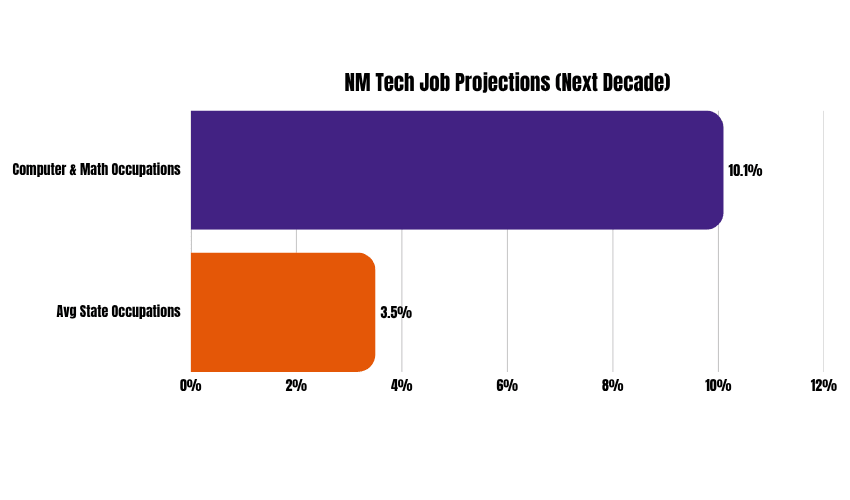
The reality on the ground is that standard recruitment methods are no longer sufficient. Companies seeking competitive tech jobs Rio Rancho must look beyond traditional, out-of-state relocation strategies. They must demand that municipalities invest in structured, data-driven training models.
The Friction Point: Qualitative Pipelines vs. Quantitative Realities
Corporate site selectors prioritize labor density above tax incentives. When a business plans an expansion, the executive team must answer a fundamental question: can the local market supply the necessary specialized developers, data scientists, and systems analysts?
There is a catch, though: high-tier technical talent is historically mobile. Smaller municipal areas often lose their brightest analytical minds to primary technology hubs like Silicon Valley or Seattle.
To counter this talent flight, workforce development New Mexico initiatives must start early, yet current efforts are hampered by a total lack of quantitative coordination. High schools and colleges coordinate on curriculum design, but these discussions are based on historical anecdotes rather than real-time vacancy metrics.
Without a localized, real-time demand dashboard, educators are essentially shooting in the dark. Sandoval Economic Alliance identifies this information asymmetry as a critical threat to economic development. The organization is actively calling for a modernized, quantitative framework to keep local talent within Sandoval County.
The Missing Link: Why Rio Rancho Urgently Needs a Real-Time Dashboard
To close the $10.1\%$ gap, regional stakeholders must move away from isolated education models. They must build a synchronized, multi-tier pipeline that connects public schools, higher education, and private industry through a shared data architecture.
Rio Rancho Public Schools and Early Tech Integration
Rio Rancho Public Schools is attempting to reshape its secondary curriculum to introduce students to technical pathways early. Instead of general science courses, high schools are offering specialized instruction in programming languages, network architecture, and data management.
This early exposure changes the career trajectory of local students. However, without a real-time dashboard tracking local hiring trends, these programs risk teaching obsolete coding frameworks. High school curriculum updates take years to implement, whereas corporate tech stacks change in months.
CNM and Rapid-Response Workforce Integration
Central New Mexico Community College (CNM) provides the mid-tier bridge in this pipeline. CNM designs fast-track certificate programs and associate degrees, but its structural agility is bottlenecked by the absence of direct employer data feeds.
If a local cybersecurity firm needs systems administrators, CNM can theoretically deploy a targeted bootcamp. In practice, the lack of real-time communication between private HR databases and public academic registries delays these deployments. This data lag increases the time-to-hire for corporate employers, forcing companies to look out of state or stall expansions.
The establishment of a real-time, quantitative workforce dashboard would solve this alignment problem. By feeding live job descriptions, required skill sets, and vacancy durations directly from employers to RRPS and CNM, the city can match training output to industrial needs with mathematical precision.
The Site Selection Advantage: Cost of Living and Talent Retention
Labor costs are only one part of the site selection equation. Employee retention depends heavily on the local cost of living. If workers cannot afford housing near their office, employee turnover rises.
The data suggests Sandoval County holds a distinct advantage in this area, provided the talent pipeline can be quantitatively stabilized. According to the 2025 Annual Cost of Living Report, the Sandoval-Rio Rancho NM region features a highly competitive cost of living composite index of 93.1.
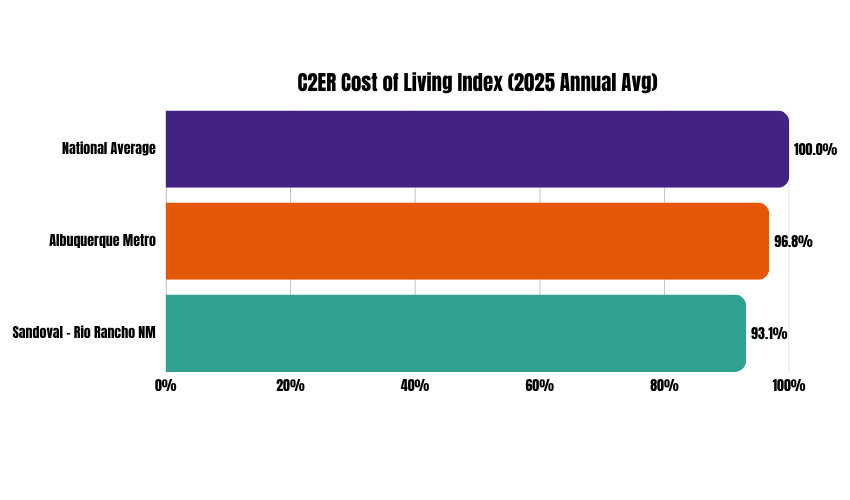
This composite index sits below the Albuquerque metro index of 96.8, and is significantly lower than the national average baseline of 100. Specifically, the housing index for Sandoval-Rio Rancho stands at 92.0, while utilities are exceptionally low at 84.7.
For a software engineer, this cost-of-living advantage means a higher quality of life. For corporate HR departments, it means lower upward pressure on salaries. It allows companies to offer competitive compensation packages that go further locally than they would in high-cost coastal markets.
The Bottom Line: Strategic Action for Employers
The 10.1% math and computer talent gap is not a distant threat, it is an active structural deficit. Municipalities that rely on qualitative, legacy education models will see their corporate employers stall or relocate.
The bottom line is this: Rio Rancho has the raw materials, competitive cost advantages, and educational institutions to secure a sustainable talent pool. What it lacks is the real-time data infrastructure to bind these elements together.
For businesses planning their next expansion, the lesson is clear. Do not select a site based on short-term tax rebates. Select a site that is actively building a quantitative, data-driven solution to its technical talent deficit.
Please contact Sandoval Economic Alliance to evaluate localized labor data, tour training facilities, and advocate for the joint development of a real-time municipal workforce dashboard.