
Castelion’s Project Ranger campus is establishing 21 structures across 1,000 acres in Sandoval County. This $220M manufacturing footprint immediately positions Rio Rancho as a primary western center for hypersonic defense hardware development and the Hypersonic Supply Chain. The scale of this corporate expansion creates a direct, high-value opening for regional precision machine shops and industrial subcontractors.
Here is the friction point: headline corporate expansions do not automatically guarantee local subcontracts. Defense aerospace giants operate under rigid federal mandates. A local machine shop cannot simply submit a standard commercial bid. The reality on the ground is that regional suppliers must adapt their security protocols, shop floors, and workforce skills to strict Department of Defense (DoD) regulations to secure these contracts. For engineering and manufacturing firms operating out of Rio Rancho, capturing a slice of this aerospace investment requires an immediate operational shift toward high-compliance defense aerospace manufacturing and the Hypersonic Supply Chain.
Understanding the intricacies of the Hypersonic Supply Chain is crucial for local businesses aiming to thrive in this sector.
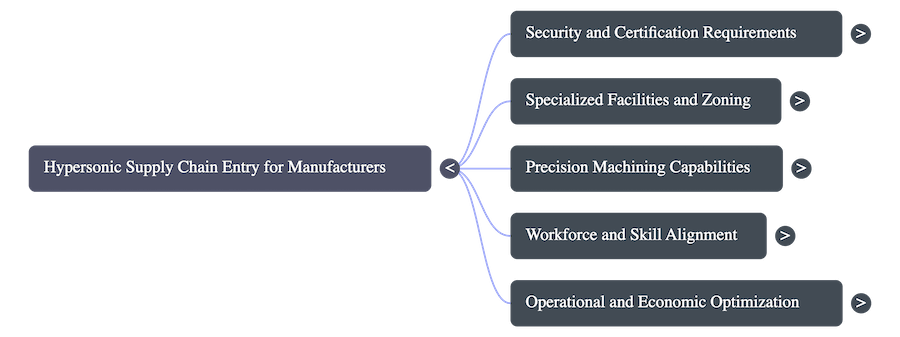
Understanding the Hypersonic Supply Chain: Security and Certification Requirements
Cybersecurity and AS9100 Registration
Subcontractors looking to secure aerospace manufacturing opportunities in New Mexico must achieve specific certifications. These baselines are non-negotiable for defense aerospace projects:
- AS9100 Quality Systems: This standard governs aerospace-specific quality management. It builds upon traditional manufacturing frameworks by enforcing absolute material traceability, rigid risk mitigation steps, and continuous configuration control for every component. Subcontractors must verify the exact source of every metal alloy batch, keeping complete digital records to ensure zero material degradation during production.
- NIST SP 800-171 Protocols: Subcontractors handling defense aerospace contracts must protect Controlled Unclassified Information (CUI). This mandate means local manufacturing facilities must rebuild their internal digital networks. Machine shops must implement multi-factor authentication, segregated secure servers, and strict access controls across all automated assets.
Specialized Industrial Zoning and Facilities
Hypersonic manufacturing structures deviate sharply from standard commercial warehouses. High-rate testing, advanced composite fabrication, and propellant handling demand industrial spaces built to exact physical specifications.
- Blast Mitigation and Containment: Facilities working with advanced high-pressure systems or specialized chemical processes must incorporate reinforced structural enclosures.
- Physical Security Perimeters: Production floors require reinforced concrete pads to minimize machine tool vibration, alongside dedicated physical security barriers and electronic access controls.
Engineering for Extremes: Precision Machining Requirements
Hypersonic flight introduces material stress profiles that push conventional physics to its limits. Vehicles operating at or above Mach 5 experience extreme thermal loading and severe structural pressure. Consequently, the machining infrastructure needed to fabricate these components requires significant capital investment and highly technical expertise.
Advanced Multi-Axis CNC Systems
Standard three-axis vertical milling machines cannot execute the complex aerodynamic surfaces required for modern hypersonic vehicle profiles. Regional machine tool fleets must deploy continuous five-axis CNC machining configurations. These advanced setups permit cutting tools to approach raw stock from five distinct angles simultaneously. This setup enables the fabrication of complex internal cooling channels and variable-curvature surfaces in a single production step. This capability removes positioning variances, allowing local machine shops to maintain tolerances measured in tight microns.
Hard Metal and Composite Machining
Hypersonic airframes rely on superalloys and advanced composites to maintain structural integrity under extreme friction. Local machine shops must upgrade their industrial footprints to process these materials cleanly and efficiently without degrading the underlying structural properties.
| Material Class | Common Alloys / Composites | Machining Challenges | Equipment Requirements |
| Superalloys | Inconel, Titanium, Cobalt-Chromium | High thermal resistance, extreme tool wear | High-torque spindles, high-pressure through-spindle coolant |
| Composites | Carbon-Carbon, Ceramic Matrix Composites (CMCs) | Material delamination, highly abrasive dust | Diamond-coated tooling, specialized dust-extraction enclosures |
Local Economic Dynamics and Resource Optimization
Operating an advanced aerospace manufacturing facility incurs significant overhead costs. Continuous multi-axis milling operations, temperature-regulated cleanroom environments, and dedicated dust extraction hoods consume substantial power. The data suggests an advantageous economic environment for firms willing to invest in these sophisticated technical upgrades in Sandoval County.
According to data in COLI 2025 Annual Average_2.pdf, the Sandoval-Rio Rancho area maintains a cost of living composite index of 93.1, which sits comfortably below the national baseline of 100. More importantly, the local industrial utility index ranks at a highly favorable 84.7. This relative affordability extends directly into key operating overhead sectors. Lower relative operational costs provide local firms with an immediate margin buffer. This utility cost advantage allows regional businesses to absorb the upfront capital expenditures associated with security clearings and advanced machinery upgrades more easily, making their contract bids highly competitive against coastal aerospace clusters.
Aligning with Regional Development Pipelines

There is a catch, though: sophisticated machinery is useless without qualified technicians to program and run the production lines. High-precision hard metal machining and AS9100 document workflows require specialized technical literacy. The data suggests that computer and mathematical occupations in New Mexico are projected to expand by 20.3 percent between 2023 and 2033. Architecture and engineering roles are projected to grow by 12.0 percent over the same decade.
This matters because our region needs to actively align industry needs with educational curricula to support this growth. Regional educational institutions must design training pipelines that sync directly with advanced defense manufacturing requirements. Central New Mexico Community College remains an important regional asset for technical training, producing 10,728 program completers during the 2022–2023 academic year according to a State of the Workforce document published in 2025. Local curriculum planners must integrate specific coursework in multi-axis CNC programming, aerospace quality control, and defense-grade welding certifications. This educational alignment will give expanding machine shops immediate access to specialized local operators, transforming regional labor pools into highly specialized defense contractors in Rio Rancho.
The bottom line is this: the infrastructure footprint for modern defense innovation is actively expanding across Sandoval County. Regional suppliers that proactively modernize their security infrastructure, secure AS9100 certification, and invest in multi-axis precision machining will position themselves at the forefront of this industrial transition.
Operational Standards for Regional Subcontractors
To participate effectively in the regional defense aerospace manufacturing ecosystem, local businesses should structure their corporate site selection and facility plans around these key criteria:
- Specialized Zoning Compliance: Subcontractors must secure appropriate heavy industrial zoning to allow specialized chemical processing and high-pressure material testing safely.
- Physical Facility Upgrades: Production floors require reinforced concrete pads to minimize machine tool vibration, alongside dedicated physical security barriers and electronic access controls.
- Workforce Pipeline Development: Expanding firms must coordinate early with local workforce development offices to source technicians trained in advanced metallurgy and AS9100 quality documentation.
Sandoval Economic Alliance provides comprehensive site selection reports, detailed regional labor data, and infrastructure maps to assist businesses seeking to join this expanding aerospace cluster. Discover how your firm can integrate into the regional aerospace supply chain by contacting Sandoval Economic Alliance for comprehensive site selection data, industrial infrastructure maps, and local business expansion opportunities.
References
- Council for Community and Economic Research. (2026). Cost of Living Index: 2025 Annual Average Data (Vol. 58, No. 4). C2ER. [COLI 2025 Annual Average_2.pdf]
- New Mexico Department of Workforce Solutions. (2025). New Mexico 2025 State of the Workforce: A Report Highlighting New Mexico’s Current and Future Workforce. NMDWS Economic Research & Analysis Bureau. [State_of_the_Workforce_2025_2.pdf]